
Tier 3 or Tier 4: Which Colocation Is Right for Your Business?

In India’s fast-growing digital economy, speed, reliability, and uptime are not just nice-to-haves; they’re business-critical. Whether you run an e-commerce platform, a SaaS firm, a financial services company, or a high-traffic web portal — the data center you choose can make or break your user experience and reputation. Two of the most talked-about options are Tier 3 and Tier 4 colocation or data-center facilities.

In this blog post, we’ll compare them in the context of the Indian market (especially cities like Mumbai or Delhi), and highlight why a service like the one from ESDS provide just the right balance between reliability and cost for many businesses.

Understanding Data Center Tiers: What They Mean

The concept of “data center tiers” comes from Uptime Institute — a globally recognized body that evaluates data-center infrastructure. The tiers (from 1 to 4) reflect increasing levels of redundancy, fault tolerance, and uptime guarantees.

Here’s an overview:

  • Tier 1: Basic facility — single path for power/cooling, no redundancy. Uptime 99.671%.
  • Tier 2: Some redundancy (partial N+1), but still limited. Uptime 99.741%.
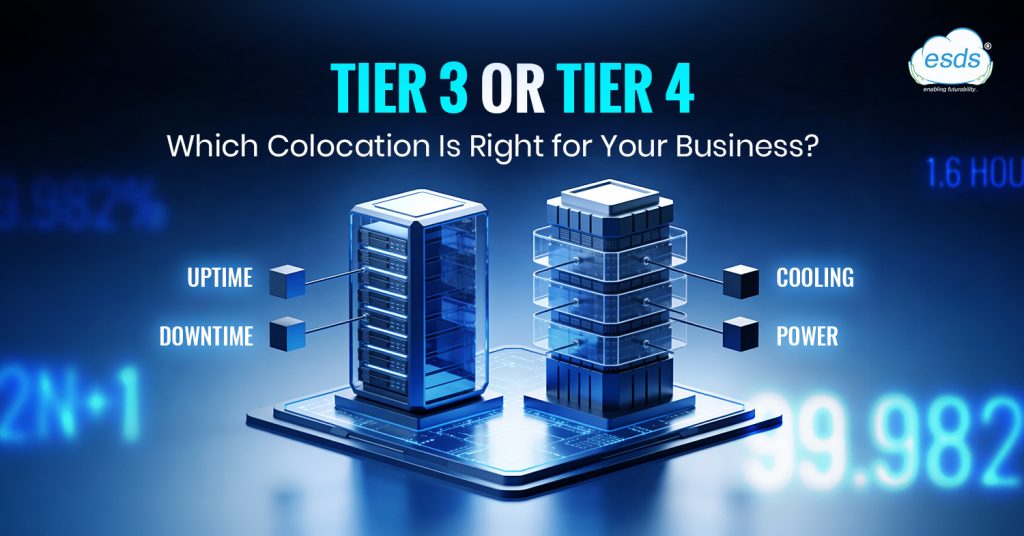
  • Tier 3: Fully redundant paths for power and cooling, N+1 redundancy for components, and capability for concurrent maintenance. Uptime 99.982%. Downtime limited to 1.6 hours per year.
  • Tier 4: Fault-tolerant facility with 2N or 2N+1 redundancy (i.e. every critical component is duplicated), physically isolated systems, fully independent distribution paths — meaning even during maintenance or component failure, services run uninterrupted. Uptime 99.995%, downtime under 26 minutes per year.

Because each tier builds upon the previous, a Tier 4 data center inherently meets all the requirements of Tier 3 — and then some.

Nevertheless, a higher tier doesn’t always automatically translate to “better fit” — it depends on your actual business needs and risk profile.

Who Should Use Tier 3 and Who Needs Tier 4?

When Tier 3 is important

Tier 3 is often the sweet spot for many businesses — especially in India — because it offers significant reliability without the huge cost overhead of a Tier 4 facility. Typical use cases:

  • Companies handling non-mission critical workloads, internal applications, standard hosting, backups, dev/staging environments.
  • SMEs / mid-size firms that need high availability, but don’t have 24×7-global-traffic or extremely stringent uptime requirements.
  • Businesses looking for colocation with good redundancy for growth, but want to avoid overpaying for infrastructure they don’t fully need.

With an expected downtime of just 1.6 hours per year, a Tier 3 data center offers “good enough” reliability for a large number of business applications, while keeping costs relatively reasonable.

When Tier 4 becomes essential

Tier 4 makes sense when downtime is absolutely unacceptable, or when your infrastructure has to support heavy, continuous traffic, strict SLAs, or mission-critical workloads. Examples:

  • Financial services, banking, fintech — where every minute of downtime can cost money, compliance, or reputation.
  • Large-scale e-commerce / online marketplaces with high traffic volumes and peak loads.
  • Real-time services or SaaS platforms used globally, including 24×7 operations.
  • Enterprises with compliance / regulatory requirements and risk-averse clients who demand “always on” availability.

With downtime reduced to less than 26 minutes a year — even during maintenance — Tier 4 data centers provide the highest-level fault tolerance and availability.

Tier 3 /Tier 4 Colocation Facilities: What Works for Indian Businesses

While global standards define what “Tier 3” or “Tier 4” means, on-the-ground reality and pricing differ widely, especially in India.

  • In major metros such as Mumbai or Delhi — where latency, data-proximity, regulatory compliance, and connectivity matter — picking the right tier becomes more strategic than just technical.
  • Many Indian businesses don’t actually need the “absolute uptime bullet-proofing” that Tier 4 offers — but they still want stability, security, and professional-grade infrastructure.
  • Colocation providers in India, including those offering Tier 3 facilities, now come with robust redundancy, modern cooling, backup power, and managed services — making them a solid fit for many firms.

This is where a colocation provider like ESDS becomes relevant.

ESDS: The Right Partner for Your Business Need

ESDS offers colocation services through its network of Tier III-certified data centers located across India — Nashik, Navi Mumbai, Bengaluru, and Mohali.

Here’s why many businesses, especially in Mumbai, Delhi NCR, or other metro clusters, consider ESDS:

  • Purpose-built Tier III data centers — designed for redundancy (power, cooling), high-availability infrastructure, and professional-grade security.
  • Managed colocation & flexibility — ESDS provides not only rack space, power, and cooling, but also managed services like backup, monitoring, network management — freeing businesses from the hassle of maintaining physical infrastructure.
  • Scalable & geographically distributed footprint — with multiple data centers across India, ESDS enables enterprises to co-locate servers near their user bases (e.g. Mumbai or Delhi), improving latency and compliance.
  • Cost-conscious reliability — For many growing businesses, ESDS’s Tier III colocation offers a reliable, enterprise-grade infrastructure without the premium of a full Tier 4 facility — making it a pragmatic, business-friendly choice.

Tier 3 vs Tier 4 : A Comparison for Indian Businesses

FactorTier 3Tier 4
Uptime guarantee99.982%99.995%
Redundancy / Fault ToleranceN+1 redundant power/cooling paths; can perform maintenance without downtime.2N or 2N+1 full redundancy; dual independent systems ensuring fault tolerance even during failures.
Typical Use CasesLarge SMEs, high-traffic sites with moderate tolerance for maintenance downtime, internal hosting, backup, colocation.Critical services — finance, large-scale SaaS, e-commerce, high-availability global platforms.
CostLower compared to Tier 4 — good cost-to-performance ratio.Higher — because of more redundancy, infrastructure, maintenance complexity.

How to Decide: Which Tier Is Right for Your Business?

Here are the questions you should ask when choosing between Tier 3 and Tier 4:-

  1. How critical is uptime for your business?
    • If even a few hours of downtime per year could mean huge revenue loss, compliance failure or reputational damage — Tier 4 merits consideration.
    • If your business can tolerate occasional maintenance windows or minimal downtime — Tier 3 often offers the best balance.
  2. What’s your budget vs. value proposition?
    • Tier 4 involves higher capital expenditure (or recurring costs, in colocation). If your ROI from that extra uptime doesn’t justify the cost — Tier 3 makes financial sense.
    • For budget-conscious firms wanting enterprise-grade reliability, colocation with a provider like ESDS gives you infrastructure you probably wouldn’t want to invest in building from scratch.
  3. What’s the nature of your workloads?
    • Are you running mission-critical applications, financial transactions, real-time services, e-commerce or regulated workloads (healthcare, payments)? If yes — Tier 4 or equivalent redundancy is wise.
    • If you host websites, internal databases, backups, dev/staging environments, or moderately trafficked services — Tier 3 is typically sufficient.
  4. Do you need geographical presence in specific metros (Mumbai, Delhi, etc.)?
    • If you want to keep data closer to your end-users for latency or compliance, or if you want distributed presence — look for a colocation provider with multiple data centers across India (like ESDS).
    • You may get better latency, redundancy, and cost-effectiveness than rolling out your own data centers.
  5. What about flexibility and scalability?
    • Colocation providers often let you scale up/down — ideal for businesses growing in phases.
    • Building or leasing a Tier 4 facility may involve high CAPEX and long-term commitment, which may not align with growth plans.

For many Indian companies — mid-size firms, high-traffic websites, SaaS platforms, local e-commerce players, and growing businesses — a Tier 3 colocation solution from a reliable provider like ESDS offers a great balance of reliability, affordability, and scalability.

On the other hand, if you operate a business where every second of downtime matters (e.g. payment processing, online trading, global-scale SaaS, real-time services), then you should strongly consider Tier 4 — or a distributed “multi-zone” architecture using multiple Tier 3 data centers to achieve redundancy at a lower overall cost.

For many businesses in Mumbai, Delhi, or other Indian metros, Tier 3 + colocation offers optimal cost-to-performance-value, while the “upgrade” to Tier 4 makes sense only when your risk and cost of downtime dramatically outweighs infrastructure cost.

Final Thoughts

Choosing a data center tier isn’t just a technical decision — it’s a strategic one. While Tier 4 represents the pinnacle of redundancy and uptime, it also comes with significantly higher cost and complexity. Many businesses — especially in India — will find that a well-run Tier 3 colocation facility delivers more than enough reliability, redundancy, and scalability to meet their needs.

If you want a data-center partner that understands the Indian market, offers robust colocation in Mumbai, Nashik, Bengaluru and beyond, and balances cost with reliability — ESDS is definitely worth evaluating.

That said, every business is unique. The “right fit” depends on your uptime tolerance, workload criticality, budget, and growth plans. Use this guide as a starting point — and do a detailed evaluation of your own business needs before committing.
Why Tier III Datacenters Are Now the BFSI Standard in India?

The Indian BFSI sector has been quietly reshaping its tech backbone over the last few years. Digital transactions are soaring, fraud patterns keep mutating, and regulators expect tighter control over everything—from uptime to data handling. With this constant pressure, financial institutions are rethinking where their core systems should live.
And one pattern stands out: Tier III datacenters are gradually becoming the default home for critical banking workloads.

If you look around, most of the heavy lifting—core banking, payments, settlement engines, regulatory reporting, even fraud analytics—now sits inside Tier III facilities. They’ve become the safe, sturdy middle ground the financial sector trusts.

So, why Tier III? Because BFSI wants an infrastructure that doesn’t flinch

1. Redundancy That Keeps Banking ALive

Tier III setups offer N+1 redundancy across power, cooling, and network pathways. It basically means there’s always a spare route, a spare system, a spare backup ready to kick in.
For BFSI, where even a 10-second outage can freeze an ATM network or disrupt UPI flows, that’s not a luxury—it’s oxygen.

You get:

  • Maintenance without shutdowns
  • Fewer single-point failures
  • A stable base for high-density workloads like fraud monitoring and transaction processing

No wonder many CIOs quietly agree that Tier III has become the “minimum acceptable” environment.

2. Matching India’s Regulatory Pulse

Banks and insurance players live under a microscope. Between RBI, IRDAI, and MeitY guidelines, the expectations are crystal clear:

  • Keep data within India
  • Maintain strict uptime
  • Track and control every access point
  • Ensure multi-zone protection
  • Maintain auditable, tamper-proof systems

Tier III datacenters naturally support this ecosystem with their structured zones, controlled access, predictable uptime, and environment stability. For BFSI teams, this reduces the maze of compliance overhead and lets them focus on improving services instead of babysitting infrastructure.

3. Fueling Digital Banking and AI-Heavy Workloads

Modern BFSI tech stacks aren’t simple anymore. You’ve got:

  • API-based banking
  • Digital onboarding
  • Real-time settlements
  • AI-driven fraud detection
  • Personalization engines
  • Cloud-native core banking upgrades

These workloads crave consistency—steady power, stable temperature, reliable hardware, and smooth performance under load. Tier III facilities offer all of that without wobbling.

As digital payments grow and fintechs push innovation faster, Tier III datacenters give BFSI teams the confidence that their infrastructure won’t become a bottleneck.

4. The Big Colocation Wave in Indian BFSI

There’s a noticeable shift happening: banks are moving away from running everything in-house. The cost, the manpower, the monitoring—it’s too heavy.
Colocation is filling that gap, especially inside Tier III environments.

Why? Because colocation offers:

  • Controlled capex with predictable opex
  • Space for high-density AI or analytics racks
  • Stronger security without expanding internal facilities
  • Faster rollout of digital products
  • Simplified disaster recovery designs

5. Security That Keeps Pace with Threats

Security sits at the center of every BFSI decision. Tier III datacenters bring multiple layers of defense:

  • Biometric access
  • 24×7 surveillance and SOC monitoring
  • Segregated network lanes
  • Compliance-ready logs
  • Fire suppression and climate-controlled zones
  • Redundant sites for Disaster Recovery

6. Cost Efficiency Because Standardization Works

One underrated perk of Tier III setups is cost discipline. When providers run at scale, customers naturally benefit.

BFSI clients get:

  • Shared power and cooling investments
  • Physical separation without huge infrastructure cost
  • Smaller internal teams needed for upkeep
  • Predictable pricing for compute and network

What offering does ESDS BFSI Community Cloud offers

ESDS provides BFSI Community cloud with regulation cloud environment built specifically for Indian banks, and also other financial institutions.

  1. Compliance & Sovereign – it satisfies data localization norms and regulatory mandates, giving institutions freedoms about data residency and audit readiness.
  2. Vertical auto-scaling & cost-efficient mode – Built on ESDS patented eNlight Cloud platform, the cloud can automatically scale compute and storage resources as demand fluctuates.
  3. End-to-End Services – From core banking systems to digital payment rails, regulatory reporting, document management, disaster recovery, and even newer services like AI-based analytics.
  4. GPU-as-a-service – ESDS’ GPU-as-a-Service (GPUaaS) platform provides banks, NBFCs and fintech players access to high-powered GPU clusters in a secure, compliant environment

ESDS BFSI Cloud bridges the gap between regulatory compliance, cost-sensitivity, and modern banking needs.

Wrapping it up

India’s BFSI ecosystem is standing at an interesting crossroads. Transaction volumes are rising, fraud is getting trickier, and digital infrastructure demands are climbing fast. In this setting, institutions need datacenters that stay solid—no matter how unpredictable things get.

Tier III facilities deliver that stability, which is why they’re rapidly becoming the go-to foundation for secure banking IT. And when paired with BFSI colocation and community cloud setups, the whole architecture becomes even stronger and more future-ready.

This shift isn’t just about tech. It’s a strategic move, one that sets the tone for how India’s financial sector will operate in the years ahead.

FAQs

1. Why is Tier III hosting preferred for BFSI?
Because it offers reliable N+1 redundancy, strong uptime, and compliance support. It fits mission-critical workloads like payments, core banking, and regulatory systems.

2. How does BFSI colocation help with regulations?
Tier III colocation providers support strict access controls, data localization, uptime commitments, and continuous monitoring.

3. What’s the purpose of a BFSI Community Cloud?
It gives banks and financial institutions a ready-made, policy-aligned environment for apps, data, and analytics. It also speeds up deployment and blends smoothly with Tier III setups.

4. Is Tier III suitable for analytics or AI-heavy banking workloads?
Tier III facilities handle high-density racks and deliver consistent power and compute performance, supporting fraud analytics, predictive models, and real-time engines.

5. How does Tier III strengthen secure banking IT?
Through layered physical security, network segregation, continuous monitoring, and redundant infrastructure—all designed to keep sensitive financial data safe and available.

Data Center Predictions for 2022

Data Center services

The outburst of the ongoing pandemic in late 2019 and throughout 2020 & 2021 forced various CIOs from different industries to enhance their focus towards gaining operational agility. To remain competitive in their business domains, it is getting inevitably essentially important for a business to adopt Digital Transformation & prioritize their technology trends, such as Data Center Services. Apart from the technological front, CIOs and business heads also must emphasize talent retention & improve business relationships with their stakeholders. Various top Data Center providers have time and again highlighted the challenges associated with Data Center growth &  the role of Data Center Solutions in creating a digitally ready futuristic society.

Data Center Predictions for 2022

Impact of Pandemic on Demand for Data Centers in India

The outcome of an IT spending survey suggests more than 65% of enterprises of Indian enterprises have understood the benefits of opting for a Cloud-based service to acquire new clients, serve the existing customer base & gain profitability. About 81% of corporate organizations have adopted Cloud Services owing to the pandemic as the implementation of work from home culture got predominated. During the first quarter of 2020, the spending of enterprises on Cloud infrastructure enhanced by ~35% compared to Quarter 4 of 2019 (Source: Ken Research).

Data Center Services in India.
Source: Interview with Industry Experts and Ken Research Analysis

The research clearly inferred that the pandemic served as a blessing in disguise for Data Center Services in India.

Expected Trends in Data Center Industry

1. Growth of Edge Computing

Recently, there has been a multi-fold demand for highly available & low latency networks, with end-users demanding digital content services. Organizations aim to enhance their IT flexibility by providing an improved customer experience. End-users are also looking to use Colocation Data Center services to out-grow their edge computing capacities in their core areas. Instead of having a centralized repository for all their assets, enterprises look to create diversified network data that remain closer to their end-users. Edge computing offers users high-performance networks for their work-related requirements.

2. Growth of Small Data

Small Data is usually linked with edge computing in applications demanding lower latency. Small data infrastructure boosts a faster analysis for all those data that demand high availability & bandwidth. It is important to understand that small data doesn’t eliminate Data Centers; rather, it facilitates their usage since edge computing processes data locally. Overall, this boosts the need for applications with low latency, connecting devices to colocation Data Center providers. Thus, it is clear that there will be a broad-scale adoption of devices that will use Small Data capabilities in the coming years.

3. Resiliency & Uptime Continues to Be the Core Focus Area

Assuring maximum uptime for hosted critical applications & data is always the top priority for any Data Center services provider. However, maintaining uptime has been a challenge as more companies are now opting for a hybrid infrastructure, involving backup and failover strategies, including Cloud, Colocation & on-premises facility. On the operational front, users continue to optimize their IT infrastructure to match with any failure or outage, with its impact depending on the Data Center provider.

4. Accelerated Investments in Regional Markets

The influx of global capital has increased digital infrastructure growth in all regions. Much of the capital investment is being made by adding more Data Center Services across major Data Center market chunks. In 2022, there will be a deep penetration of some best Data Centers within Tier 2 & Tier 3 cities due to localized users’ data hosting & security needs.

Indian markets have witnessed an increased focus on Data Recovery & Disaster Recovery Management services being offered by leading Tier 3 Data Centers in India, driving the expansion of the market across different cities. High penetration of OTT in the rural market has resulted in an increased need for Data Centers Services in India.

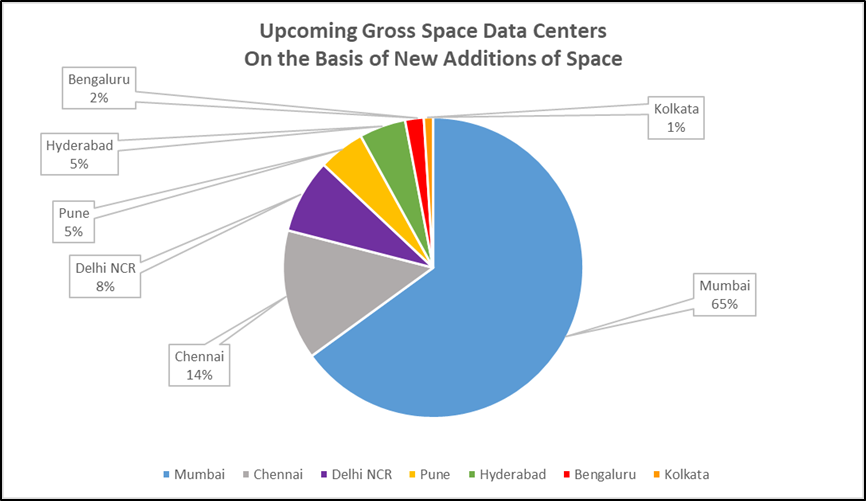
Below is the illustration depicting the details of upcoming gross space Data Centers by region (in India) based on new space additions (in %). This is from March 31, 2020, to March 31, 2025.

Data Centers Services in India.
Source: JLL, Industry Articles, Interview with Industry Experts, Ken Research Analysis

5. Liquid Cooling Data Centers

The Data Center industry is continuously changing its focus to adopt liquid emersion cooling Data Centers. In the coming year, significant advancements will be made in this direction due to reassessed cooling demand for avoiding usage of excess water for cooling hardware.

6. Cloud Diversification: Emergence of Multi Clouds

Today, Enterprises don’t rely on a single Cloud Provider to manage their technological needs. Instead, they tend to avail services of a single Cloud provider, often termed as Multi-Cloud. With Multi-Cloud, enterprises enhance their capability to transform their business areas completely. Enterprises can migrate, modify & redeploy their workloads with different Cloud providers and address the changing needs of their customers.

7. Microgrids

The concept of Microgrids is becoming a notable trend as a notable on-site generator within the premises of some best Data Centers. With microgrids in place, Data Center Services get access to multiple energy sources, ensuring they operate independently of the installed energy grid in case of outages or disasters. Data Center microgrids can be easily integrated with renewable energy sources, resulting in in in lower carbon emissions. Microgrids can be of great significance as the Data Center providers are looking to become green Data Centers through these alternate & clean sources of energy.

8. AI & Automation for Easing Data Center Tasks

The current pandemic resulted in a reduced number of on-site technicians and domain experts who could handle any data center problem. Advanced technologies like AI & Machine Learning can be of great help in remote management & monitoring of Datacenters. Automation could find its best usage for driving infrastructure management using robotics. With huge volumes of data being generated & stored within Data Centers, it will utterly surpass human handling capabilities. Hence, efficient usage automation & AI could result in accurate managing & monitoring of data stored within Data Center hosting. These technologies also have an important role in determining user data patterns & preferences.

Concluding Words

These are only some of the prominent trends that will positively impact the Data Centers, influenced by challenges thrown by the pandemic. With data volumes rising persistently, there might be more disruptions emerging, resulting in enhanced data hosting within Data Center services. Implementation of Advanced Technologies will boost Data Center hosting services by multi-folds.