
Tier 3 or Tier 4: Which Colocation Is Right for Your Business?

In India’s fast-growing digital economy, speed, reliability, and uptime are not just nice-to-haves; they’re business-critical. Whether you run an e-commerce platform, a SaaS firm, a financial services company, or a high-traffic web portal — the data center you choose can make or break your user experience and reputation. Two of the most talked-about options are Tier 3 and Tier 4 colocation or data-center facilities.

In this blog post, we’ll compare them in the context of the Indian market (especially cities like Mumbai or Delhi), and highlight why a service like the one from ESDS provide just the right balance between reliability and cost for many businesses.

Understanding Data Center Tiers: What They Mean

The concept of “data center tiers” comes from Uptime Institute — a globally recognized body that evaluates data-center infrastructure. The tiers (from 1 to 4) reflect increasing levels of redundancy, fault tolerance, and uptime guarantees.

Here’s an overview:

  • Tier 1: Basic facility — single path for power/cooling, no redundancy. Uptime 99.671%.
  • Tier 2: Some redundancy (partial N+1), but still limited. Uptime 99.741%.
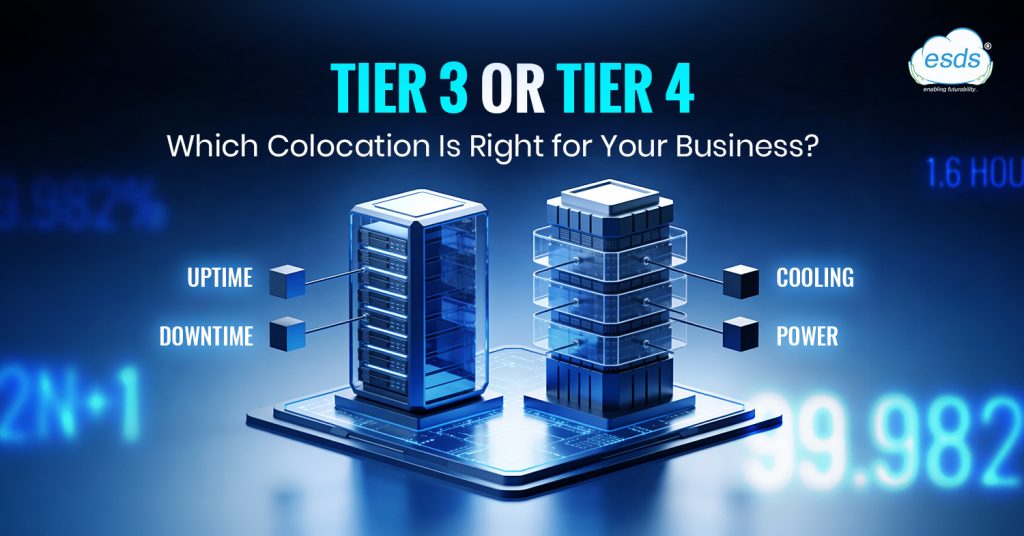
  • Tier 3: Fully redundant paths for power and cooling, N+1 redundancy for components, and capability for concurrent maintenance. Uptime 99.982%. Downtime limited to 1.6 hours per year.
  • Tier 4: Fault-tolerant facility with 2N or 2N+1 redundancy (i.e. every critical component is duplicated), physically isolated systems, fully independent distribution paths — meaning even during maintenance or component failure, services run uninterrupted. Uptime 99.995%, downtime under 26 minutes per year.

Because each tier builds upon the previous, a Tier 4 data center inherently meets all the requirements of Tier 3 — and then some.

Nevertheless, a higher tier doesn’t always automatically translate to “better fit” — it depends on your actual business needs and risk profile.

Who Should Use Tier 3 and Who Needs Tier 4?

When Tier 3 is important

Tier 3 is often the sweet spot for many businesses — especially in India — because it offers significant reliability without the huge cost overhead of a Tier 4 facility. Typical use cases:

  • Companies handling non-mission critical workloads, internal applications, standard hosting, backups, dev/staging environments.
  • SMEs / mid-size firms that need high availability, but don’t have 24×7-global-traffic or extremely stringent uptime requirements.
  • Businesses looking for colocation with good redundancy for growth, but want to avoid overpaying for infrastructure they don’t fully need.

With an expected downtime of just 1.6 hours per year, a Tier 3 data center offers “good enough” reliability for a large number of business applications, while keeping costs relatively reasonable.

When Tier 4 becomes essential

Tier 4 makes sense when downtime is absolutely unacceptable, or when your infrastructure has to support heavy, continuous traffic, strict SLAs, or mission-critical workloads. Examples:

  • Financial services, banking, fintech — where every minute of downtime can cost money, compliance, or reputation.
  • Large-scale e-commerce / online marketplaces with high traffic volumes and peak loads.
  • Real-time services or SaaS platforms used globally, including 24×7 operations.
  • Enterprises with compliance / regulatory requirements and risk-averse clients who demand “always on” availability.

With downtime reduced to less than 26 minutes a year — even during maintenance — Tier 4 data centers provide the highest-level fault tolerance and availability.

Tier 3 /Tier 4 Colocation Facilities: What Works for Indian Businesses

While global standards define what “Tier 3” or “Tier 4” means, on-the-ground reality and pricing differ widely, especially in India.

  • In major metros such as Mumbai or Delhi — where latency, data-proximity, regulatory compliance, and connectivity matter — picking the right tier becomes more strategic than just technical.
  • Many Indian businesses don’t actually need the “absolute uptime bullet-proofing” that Tier 4 offers — but they still want stability, security, and professional-grade infrastructure.
  • Colocation providers in India, including those offering Tier 3 facilities, now come with robust redundancy, modern cooling, backup power, and managed services — making them a solid fit for many firms.

This is where a colocation provider like ESDS becomes relevant.

ESDS: The Right Partner for Your Business Need

ESDS offers colocation services through its network of Tier III-certified data centers located across India — Nashik, Navi Mumbai, Bengaluru, and Mohali.

Here’s why many businesses, especially in Mumbai, Delhi NCR, or other metro clusters, consider ESDS:

  • Purpose-built Tier III data centers — designed for redundancy (power, cooling), high-availability infrastructure, and professional-grade security.
  • Managed colocation & flexibility — ESDS provides not only rack space, power, and cooling, but also managed services like backup, monitoring, network management — freeing businesses from the hassle of maintaining physical infrastructure.
  • Scalable & geographically distributed footprint — with multiple data centers across India, ESDS enables enterprises to co-locate servers near their user bases (e.g. Mumbai or Delhi), improving latency and compliance.
  • Cost-conscious reliability — For many growing businesses, ESDS’s Tier III colocation offers a reliable, enterprise-grade infrastructure without the premium of a full Tier 4 facility — making it a pragmatic, business-friendly choice.

Tier 3 vs Tier 4 : A Comparison for Indian Businesses

FactorTier 3Tier 4
Uptime guarantee99.982%99.995%
Redundancy / Fault ToleranceN+1 redundant power/cooling paths; can perform maintenance without downtime.2N or 2N+1 full redundancy; dual independent systems ensuring fault tolerance even during failures.
Typical Use CasesLarge SMEs, high-traffic sites with moderate tolerance for maintenance downtime, internal hosting, backup, colocation.Critical services — finance, large-scale SaaS, e-commerce, high-availability global platforms.
CostLower compared to Tier 4 — good cost-to-performance ratio.Higher — because of more redundancy, infrastructure, maintenance complexity.

How to Decide: Which Tier Is Right for Your Business?

Here are the questions you should ask when choosing between Tier 3 and Tier 4:-

  1. How critical is uptime for your business?
    • If even a few hours of downtime per year could mean huge revenue loss, compliance failure or reputational damage — Tier 4 merits consideration.
    • If your business can tolerate occasional maintenance windows or minimal downtime — Tier 3 often offers the best balance.
  2. What’s your budget vs. value proposition?
    • Tier 4 involves higher capital expenditure (or recurring costs, in colocation). If your ROI from that extra uptime doesn’t justify the cost — Tier 3 makes financial sense.
    • For budget-conscious firms wanting enterprise-grade reliability, colocation with a provider like ESDS gives you infrastructure you probably wouldn’t want to invest in building from scratch.
  3. What’s the nature of your workloads?
    • Are you running mission-critical applications, financial transactions, real-time services, e-commerce or regulated workloads (healthcare, payments)? If yes — Tier 4 or equivalent redundancy is wise.
    • If you host websites, internal databases, backups, dev/staging environments, or moderately trafficked services — Tier 3 is typically sufficient.
  4. Do you need geographical presence in specific metros (Mumbai, Delhi, etc.)?
    • If you want to keep data closer to your end-users for latency or compliance, or if you want distributed presence — look for a colocation provider with multiple data centers across India (like ESDS).
    • You may get better latency, redundancy, and cost-effectiveness than rolling out your own data centers.
  5. What about flexibility and scalability?
    • Colocation providers often let you scale up/down — ideal for businesses growing in phases.
    • Building or leasing a Tier 4 facility may involve high CAPEX and long-term commitment, which may not align with growth plans.

For many Indian companies — mid-size firms, high-traffic websites, SaaS platforms, local e-commerce players, and growing businesses — a Tier 3 colocation solution from a reliable provider like ESDS offers a great balance of reliability, affordability, and scalability.

On the other hand, if you operate a business where every second of downtime matters (e.g. payment processing, online trading, global-scale SaaS, real-time services), then you should strongly consider Tier 4 — or a distributed “multi-zone” architecture using multiple Tier 3 data centers to achieve redundancy at a lower overall cost.

For many businesses in Mumbai, Delhi, or other Indian metros, Tier 3 + colocation offers optimal cost-to-performance-value, while the “upgrade” to Tier 4 makes sense only when your risk and cost of downtime dramatically outweighs infrastructure cost.

Final Thoughts

Choosing a data center tier isn’t just a technical decision — it’s a strategic one. While Tier 4 represents the pinnacle of redundancy and uptime, it also comes with significantly higher cost and complexity. Many businesses — especially in India — will find that a well-run Tier 3 colocation facility delivers more than enough reliability, redundancy, and scalability to meet their needs.

If you want a data-center partner that understands the Indian market, offers robust colocation in Mumbai, Nashik, Bengaluru and beyond, and balances cost with reliability — ESDS is definitely worth evaluating.

That said, every business is unique. The “right fit” depends on your uptime tolerance, workload criticality, budget, and growth plans. Use this guide as a starting point — and do a detailed evaluation of your own business needs before committing.

Why Tier III Datacenters Are Now the BFSI Standard in India?

The Indian BFSI sector has been quietly reshaping its tech backbone over the last few years. Digital transactions are soaring, fraud patterns keep mutating, and regulators expect tighter control over everything—from uptime to data handling. With this constant pressure, financial institutions are rethinking where their core systems should live.
And one pattern stands out: Tier III datacenters are gradually becoming the default home for critical banking workloads.

If you look around, most of the heavy lifting—core banking, payments, settlement engines, regulatory reporting, even fraud analytics—now sits inside Tier III facilities. They’ve become the safe, sturdy middle ground the financial sector trusts.

So, why Tier III? Because BFSI wants an infrastructure that doesn’t flinch

1. Redundancy That Keeps Banking ALive

Tier III setups offer N+1 redundancy across power, cooling, and network pathways. It basically means there’s always a spare route, a spare system, a spare backup ready to kick in.
For BFSI, where even a 10-second outage can freeze an ATM network or disrupt UPI flows, that’s not a luxury—it’s oxygen.

You get:

  • Maintenance without shutdowns
  • Fewer single-point failures
  • A stable base for high-density workloads like fraud monitoring and transaction processing

No wonder many CIOs quietly agree that Tier III has become the “minimum acceptable” environment.

2. Matching India’s Regulatory Pulse

Banks and insurance players live under a microscope. Between RBI, IRDAI, and MeitY guidelines, the expectations are crystal clear:

  • Keep data within India
  • Maintain strict uptime
  • Track and control every access point
  • Ensure multi-zone protection
  • Maintain auditable, tamper-proof systems

Tier III datacenters naturally support this ecosystem with their structured zones, controlled access, predictable uptime, and environment stability. For BFSI teams, this reduces the maze of compliance overhead and lets them focus on improving services instead of babysitting infrastructure.

3. Fueling Digital Banking and AI-Heavy Workloads

Modern BFSI tech stacks aren’t simple anymore. You’ve got:

  • API-based banking
  • Digital onboarding
  • Real-time settlements
  • AI-driven fraud detection
  • Personalization engines
  • Cloud-native core banking upgrades

These workloads crave consistency—steady power, stable temperature, reliable hardware, and smooth performance under load. Tier III facilities offer all of that without wobbling.

As digital payments grow and fintechs push innovation faster, Tier III datacenters give BFSI teams the confidence that their infrastructure won’t become a bottleneck.

4. The Big Colocation Wave in Indian BFSI

There’s a noticeable shift happening: banks are moving away from running everything in-house. The cost, the manpower, the monitoring—it’s too heavy.
Colocation is filling that gap, especially inside Tier III environments.

Why? Because colocation offers:

  • Controlled capex with predictable opex
  • Space for high-density AI or analytics racks
  • Stronger security without expanding internal facilities
  • Faster rollout of digital products
  • Simplified disaster recovery designs

5. Security That Keeps Pace with Threats

Security sits at the center of every BFSI decision. Tier III datacenters bring multiple layers of defense:

  • Biometric access
  • 24×7 surveillance and SOC monitoring
  • Segregated network lanes
  • Compliance-ready logs
  • Fire suppression and climate-controlled zones
  • Redundant sites for Disaster Recovery

6. Cost Efficiency Because Standardization Works

One underrated perk of Tier III setups is cost discipline. When providers run at scale, customers naturally benefit.

BFSI clients get:

  • Shared power and cooling investments
  • Physical separation without huge infrastructure cost
  • Smaller internal teams needed for upkeep
  • Predictable pricing for compute and network

What offering does ESDS BFSI Community Cloud offers

ESDS provides BFSI Community cloud with regulation cloud environment built specifically for Indian banks, and also other financial institutions.

  1. Compliance & Sovereign – it satisfies data localization norms and regulatory mandates, giving institutions freedoms about data residency and audit readiness.
  2. Vertical auto-scaling & cost-efficient mode – Built on ESDS patented eNlight Cloud platform, the cloud can automatically scale compute and storage resources as demand fluctuates.
  3. End-to-End Services – From core banking systems to digital payment rails, regulatory reporting, document management, disaster recovery, and even newer services like AI-based analytics.
  4. GPU-as-a-service – ESDS’ GPU-as-a-Service (GPUaaS) platform provides banks, NBFCs and fintech players access to high-powered GPU clusters in a secure, compliant environment

ESDS BFSI Cloud bridges the gap between regulatory compliance, cost-sensitivity, and modern banking needs.

Wrapping it up

India’s BFSI ecosystem is standing at an interesting crossroads. Transaction volumes are rising, fraud is getting trickier, and digital infrastructure demands are climbing fast. In this setting, institutions need datacenters that stay solid—no matter how unpredictable things get.

Tier III facilities deliver that stability, which is why they’re rapidly becoming the go-to foundation for secure banking IT. And when paired with BFSI colocation and community cloud setups, the whole architecture becomes even stronger and more future-ready.

This shift isn’t just about tech. It’s a strategic move, one that sets the tone for how India’s financial sector will operate in the years ahead.

FAQs

1. Why is Tier III hosting preferred for BFSI?
Because it offers reliable N+1 redundancy, strong uptime, and compliance support. It fits mission-critical workloads like payments, core banking, and regulatory systems.

2. How does BFSI colocation help with regulations?
Tier III colocation providers support strict access controls, data localization, uptime commitments, and continuous monitoring.

3. What’s the purpose of a BFSI Community Cloud?
It gives banks and financial institutions a ready-made, policy-aligned environment for apps, data, and analytics. It also speeds up deployment and blends smoothly with Tier III setups.

4. Is Tier III suitable for analytics or AI-heavy banking workloads?
Tier III facilities handle high-density racks and deliver consistent power and compute performance, supporting fraud analytics, predictive models, and real-time engines.

5. How does Tier III strengthen secure banking IT?
Through layered physical security, network segregation, continuous monitoring, and redundant infrastructure—all designed to keep sensitive financial data safe and available.

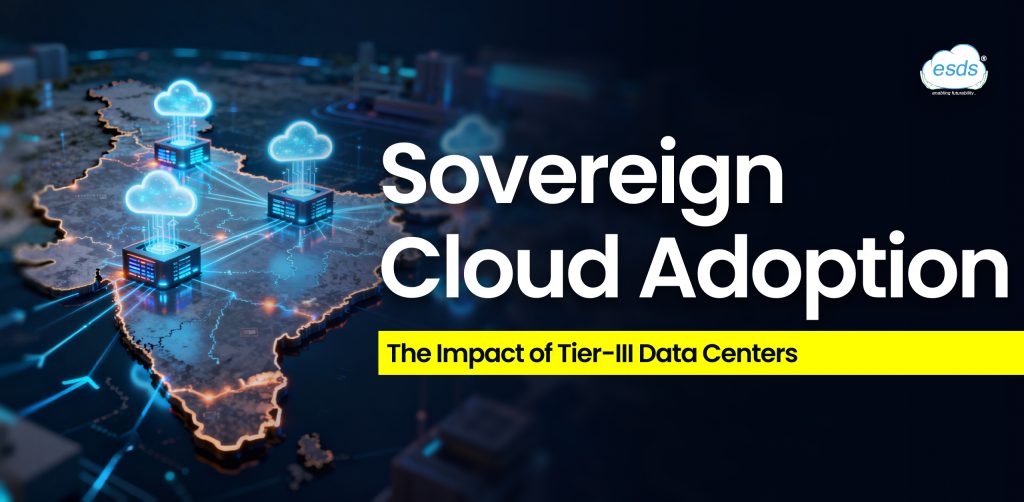
Sovereign Cloud Adoption: The Impact of Tier-III Data Centers

Evolution of data center infrastructure in india

Fast Sovereign cloud adoption, fintech innovations, and the government’s adamant support for data sovereignty in India are all contributing to India’s digital economy’s unprecedented growth. India’s sovereign cloud infrastructure, which guarantees that sensitive data, whether it be financial, governmental, or citizen-related, stays inside Indian borders and is subject to Indian jurisdiction, is at the center of this change.
Businesses must quickly transition to secure, compliant infrastructures, as highlighted by the recent Digital Personal Data Protection (DPDP) Act, RBI guidelines, and sector-specific regulations. Tier-III data centers are becoming the foundation of this independent cloud shift as data volumes soar.

Growth Trends and Market Drivers

Today India’s data center market is projected to cross 77% IT load capacity by 2027, fuelled by hyperscale expansions, government incentives, and rising enterprise workloads. Organizations are increasingly turning to enterprise colocation in India for scalable and compliant infrastructure. Colocation not only reduces capital expenditure but also provides enterprises with resilient hosting environments in certified facilities.

Regional Expansion: Rise of Tier-II and Tier-III Cities

Initially concentrated in Mumbai and Delhi NCR, India’s data center footprint is expanding rapidly into Pune, Jaipur, Bhubaneshwar, and Coimbatore. Factors such as affordable land, renewable energy availability, and improved Fiber connectivity are making Tier-II & III cities new digital hubs. This regional spread is vital for achieving both data residency in India requirements and wider accessibility for enterprises nationwide.

Understanding Tier-III + Data centers

Tier Classification Explained

Tier classifications, defined by the uptime institute, measure reliability and redundancy. Tier-III data centers offer:

  • 99.95% uptime
  • N+1 redundancy for power and cooling
  • Concurrent maintainability without downtime

Tier-IV data centers add fault tolerance and higher redundancy. Together, Tier-III+ facilities form the optimal balance of cost, reliability, and resilience required for sovereign workloads.

Why Does Tier-III+ Matter for Sovereign Cloud Adoption?

Indian sovereign cloud infrastructure relies on Tier-III+ facilities because they ensure:

  1. High Availability: Essential for BFSI, healthcare, and public services.
  2. Regulatory Compliance: Supports local data residency and audit trails.
  3. Security: Advanced surveillance, intrusion detection, and HSM-based key management.
  4. Scalability: Ability to host AI, IoT, and big data workloads.

E.g., many national payment systems and public digital goods rely on Tier-III+ colocation spaces for uninterrupted services.

Enabling India Sovereign Cloud Infrastructure

Regulatory Compliance and Data Residency

The Digital Personal Data Protection Act, RBI’s localization mandates, and sectoral frameworks in BFSI and government services make India’s sovereign cloud infra indispensable. Tier-III+ data centers enable enterprises to comply with these laws by ensuring data residency in India—critical workloads and personal data remain within Indian jurisdiction.

Enterprise Colocation: Meeting Performance and Control Needs

Large enterprises and public sector institutions are increasingly choosing enterprise colocation in India to balance cost, performance, and sovereignty. Through data center colocation services, enterprises get:

  • Customizable infrastructure with direct cloud connectivity
  • Enhance security controls
  • Low-latency access to India’s growing digital ecosystem

This model supports banks, healthcare providers, and even AI-driven enterprises that cannot risk downtime and non-compliance issues.

Security, Sustainability, and Future Trends

Modern Tier-III+ facilities focus on three pillars: –

  1. Security: Layered defense with biometric access, air-gapped recovery zones, and compliance certifications (ISO, PCI-DSS).
  2. Sustainability: Adoption of green power sources, modular cooling, and PUE (Power Usage Effectiveness) optimization.
  3. Future Readiness: Integration of AI for predictive monitoring and edge deployments to bring sovereign cloud closer to end-users.

Challenges and The Road Ahead

While Tier-III+ data centers are expanding, challenges persist:

  • High Capex: Building large-scale facilities requires billions in investments.
  • Skills Gap: Limited availability of skilled professionals in advanced facility management.
  • Energy Use: Balancing digital growth with sustainability goals.

India’s Vision: A Federated and AI-Driven Sovereign Cloud

The next decade will witness India’s shift toward federated sovereign clouds, enabling interoperability across government, BFSI, and private enterprises. AI-native data centers will power real-time decision-making, while digital public goods like UPI and ONDC will continue driving demand for sovereign-ready, Tier-III+ infrastructures.

ESDS Sovereign Cloud: Leading the Way

At the forefront of this journey is ESDS Sovereign Cloud, purpose-built for India’s regulatory and digital landscape. ESDS delivers:

  • Each of the data centers has been granted “Tier-III” status by either QSA International Limited or EPI Certification Pte Ltd. and is located in close proximity to major IT and enterprise hubs.
  • Community Cloud models tailored for BFSI, government, and enterprises.
  • End-to-End compliance with DPDP Act, RBI, MeitY, CERT-in audit and others mandates
  • Integrated colocation and cloud hosting services with unmatched uptime & green energy commitments.
  • ESDS data centers guarantee uptime of at least 99.95%, supported by power redundancy services, and are backed up with disaster recovery services and supported by a 24/7 services team.

By combining sovereign control with hyperscale-grade performance, ESDS enables enterprises and governments to accelerate digital transformation without compromising sovereignty or compliance.

Frequently Asked Questions (FAQs)

  • What is a Sovereign Cloud?

A sovereign cloud ensures all sensitive data stays within India’s borders under national jurisdiction.

  • Why are Tier-III data centers crucial for Sovereign Cloud adoption?

They provide 99.95% uptime, N+1 redundancy, and compliance support for secure, always-on operations.

  • What makes ESDS Sovereign Cloud unique?

It’s purpose-built for India’s regulatory ecosystem, offering Tier-III certified, compliant, and sustainable cloud solutions.

  • How does ESDS ensure data security and compliance?

Through ISO, PCI-DSS, and MeitY-certified facilities with advanced encryption.

  • How does the DPDP Act influence cloud adoption in India?

It mandates data localization, driving organizations towards compliant, India-based cloud infrastructures.

Conclusion

India’s sovereign digital future depends on resilient and compliant infrastructure. With the rise of India’s sovereign cloud infrastructure, Tier-III data centers have become central to enabling secure, scalable, and regulation-ready services.

As enterprises adopt enterprise colocation, With India supported by providers like ESDS Sovereign Cloud, the country moves closer to a federated, sustainable, and AI-driven digital ecosystem. Tier-III+ facilities are no longer just technical assets—they are strategic enablers of India’s ambition for data sovereignty and digital self-reliance.

India’s Data Center Expansion: Key Players & Infrastructure Growth

India is undergoing a massive digital revolution, driven by internet penetration, cloud, AI, and big data analytics. With businesses, governments, and digital startup companies adopting digital transformation, the need for scalable, secure, and compliant data center solutions has never been higher.

Growth in Data Center and the Digital India Vision

India’s data center market is witnessing exponential growth. The driving factors, such as

  • 5G Deployment: 5G network deployment is driving data consumption, requiring low-latency data processing and edge computing functionality.
  • Digital India Initiatives: Government initiatives like Meghraj (GI Cloud) and Smart Cities Mission are forcing organizations to adopt cloud technology more.
  • Hybrid & Multi-Cloud Adoption: Organizations are embracing a mix of on-premise, private, and public cloud offerings to remain agile.

Top Data Center companies are expanding capacity in order to cope with increasing demand.

Why is India a good destination for Data Center Services?

  1. Geographical Advantage: positioned centrally, India makes it a good spot to link the East and the West using technology and online services.
  2. Data Localization Laws: Rules like the Personal Data Protection Bill are forcing businesses to store data within the country.

Increasing Cloud Adoption: cloud-first strategies are driving demand for trustworthy data center providers offering hybrid and private cloud hosting platforms.

Selecting an ideal Data Center Service Provider

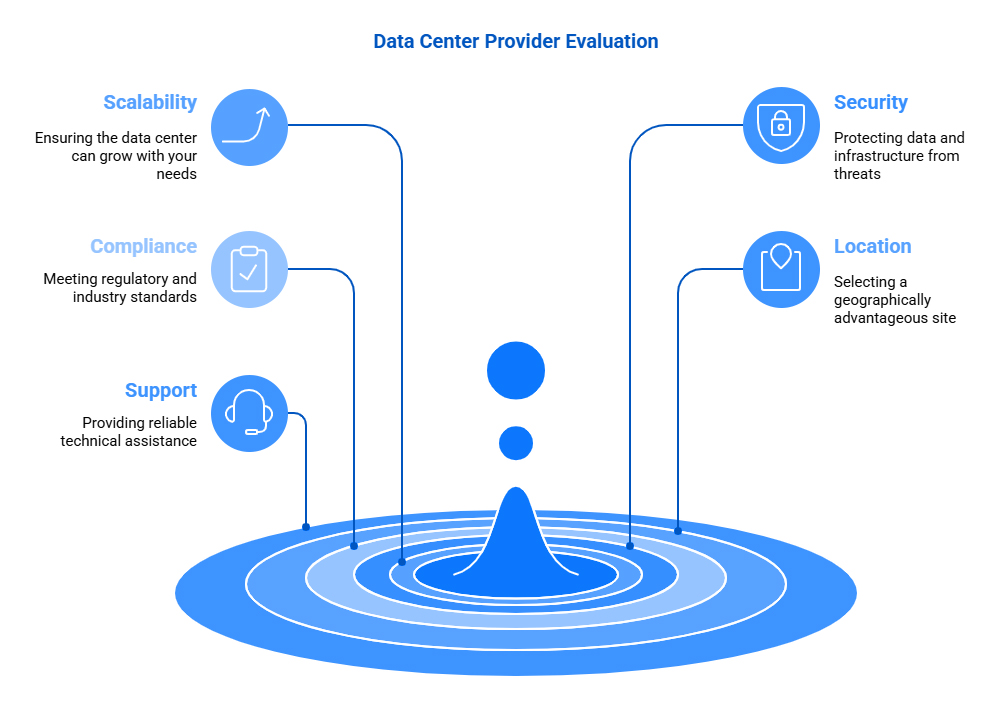
As the market becomes more competitive, selecting among top data center service providers is a sensitive process. Organizations must compare providers to key criteria:

  • Scalability: Can the provider keep pace with your expansion in the next 5–10 years?
  • Security: Are there strong physical and cybersecurity measures? How do they deal with threat detection and breaches?
  • Compliance: does the provider follow important industry rules like ISO 27001, PCI DSS, and GDPR?
  • Location: Are their data centers situated at the right locations to make data move quickly?
  • Support: Do they offer customer and technical support 24/7?

Strong Security: More Than Just Compliance

Modern data center security is not just securing the location and fitting security cameras. It involves many layers of protection, such as

  • Intrusion Detection and Prevention Systems (IDPS)
  • Biometric checks like fingerprint or face scans
  • Disaster Recovery and Backup Facilities
  • Protection from online attacks
  • Secured ways to store and send data (encryption)

The Role of Managed Data Center Services

They seek managed data center services—offered by top data center management providers—on end-to-end solutions, including infrastructure provisioning up to cost management and workload optimization.

Advantages are

  • Simple to operate
  • Enhanced Uptime and faster Performance
  • Remote Monitoring
  • Fixed and predictable costs.

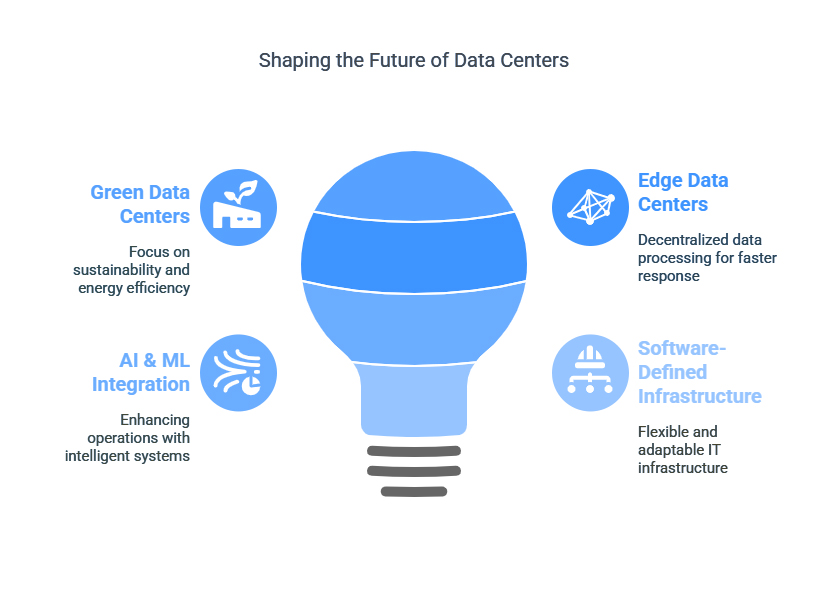
Trends that are shaping the future of Data centers

  1. Green Data Centers: Consistent with rising ESG concerns driving investment in buildings lit by solar, liquid cooling infrastructure, and energy-efficient design.
  2. Edge Data Centers: Smaller data centers placed closer to users to support fast services like IoT, AR/VR, and autonomous systems.
  3. AI & ML in Data Center Operations: Predictive maintenance, real-time threat analytics, and resource allocation.
  4. Software-Defined Infrastructure: Flexible systems that can be easily changed and managed through software instead of fixed hardware setups

Why Businesses Rely on Indian Data Center Providers

Indian Data Center providers are constructing facilities that aim to match those of international players. Why are they different?

  • Domestic talent with global vision
  • Clear understanding of regulatory mandate
  • Affordable pricing models
  • Customer-focused high Service Level Agreements (SLAs)
  • Specialised BFSI, government, healthcare, and e-commerce offerings

What lies ahead for India’s Data Center

With more industries becoming digitized —like digital banking, smart government, and telemedicine healthcare—data center management will become more important and more complex.

The future belongs to providers who can:

  • Scale dynamically
  • Maintain zero downtime
  • Deliver top-notch security
  • Align with India’s growing digital sovereignty movement

Final Thoughts

India is striving to become a world leader for data center services— government policies, a thriving digital economy, and increased demand for localized, secure cloud infrastructure.

Whether you’re a fintech startup that wants to scale, a public sector organization that wants to better serve citizens, or an enterprise that is adopting hybrid IT—ESDS Software Solution Limited aims to provide the agility, durability, and regulatory compliance that your digital tomorrow requires.

Because today, the question isn’t whether your business needs a data center. It’s whether your data center partner is future-ready. With ESDS Software Solution Limited, the answer is a confident yes.

Why Data Centers Are Critical to India’s Digital Growth?

India is undergoing a digital revolution, and at the heart of this transformation lies one essential yet often overlooked engine—data centers. As smart devices multiply, cloud computing accelerates, and internet usage crosses 1.1 billion wireless subscribers, the demand for secure, scalable, and reliable data storage infrastructure has never been higher. From powering real-time transactions and AI workloads to enabling government e-governance services, data centers form the digital backbone that supports everything from fintech to online learning. With the rapid rollout of 5G, explosive growth in digital payments, and the rise of deep-tech start-ups, India is emerging as one of the world’s fastest-growing data center services markets—and the next few years will define its trajectory.

India’s Data Center Market Size and Growth Projections

The data center market in India is currently valued at INR 82 billion, with around 85,000 racks for co-location, and is projected to grow at a compound annual growth rate (CAGR) of 21.4% from fiscal year 2020 to fiscal year 2024. The market in the future is expected to grow at a CAGR of 19.7%, from INR 82 billion in fiscal year 2024 to INR 240 billion in fiscal year 2030. As of 31st March 2024, the total data center installed capacity in India is 1050 MW, and the total utilized capacity in India for data centers stands at 850 MW.

Market Segmentation for India’s Data Center Industry by Major Cities

As of 31st March 2024, India’s current data center capacity stands at 1,050 MW, with approximately 94% of this capacity concentrated in major cities. Among these cities are Mumbai and Chennai, which lead the sector. Mumbai alone accounts for 48% of India’s total data center capacity, supported by its strategic submarine landing stations, infrastructure for power and fiber optics, and significant demand from the banking, financial services, and BFSI sectors. Meanwhile, Delhi and Kolkata serve as the primary locations in North and East India, catering to regional enterprise demand, with Delhi anticipated as a significant player with substantial capacity additions on the horizon.

Along with this, data centers are experiencing significant growth as they expand into Tier-2 and Tier-3 cities, driven by advantages and increasing demand for digital infrastructure. Cities such as Nashik, Kochi, and Jaipur are becoming key players in this expansion. Leading companies like ESDS Software Solution Limited are actively pursuing opportunities to establish their presence in these smaller cities.

End-user Segmentation by Industry

The data center market is characterized by a diverse range of end-user sectors, with the Banking, Financial Services, and Insurance (BFSI) sector leading the way, accounting for 45% of total revenues. Enterprises follow closely, representing 35% of the market, driven by their increasing reliance on cloud services and digital transformation initiatives. The government sector contributes 15%, focusing on e-governance and secure data management, while other sectors collectively make up the remaining 5%. This distribution highlights the varying needs and priorities of different industries in leveraging data center capabilities to support their operations. Players with a well-diversified presence across multiple industry segments have already built a strong foundation in the Indian data center and cloud market.

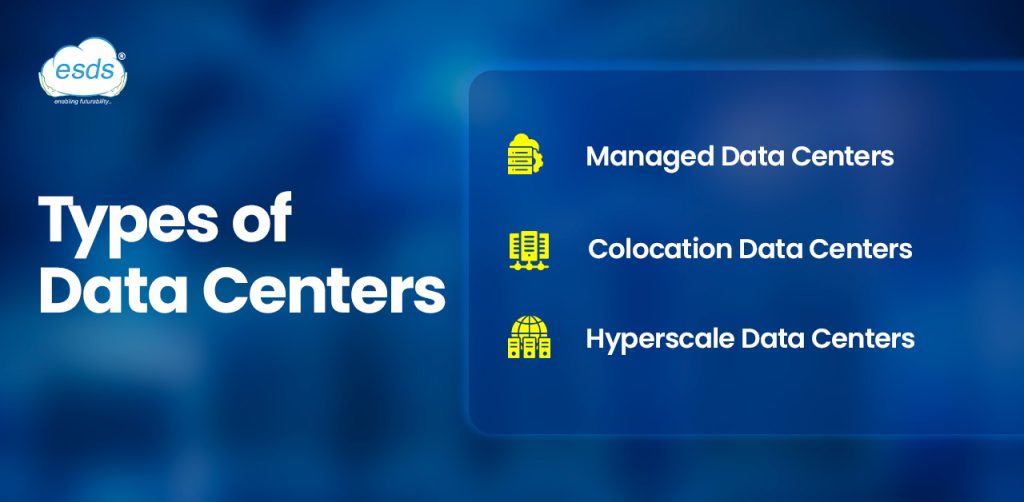
Types of Data Centers

Below is the list of data centers as shown below:

  • Managed Data Centers—Combines co-location services with managed IT support, allowing businesses to rent space for servers and outsource infrastructure management to specialized vendors. It helps businesses focus on core activities without IT management burdens.

Key Benefits:

  • Expert management of IT resources.
  • Flexible scalability
  • Focus on strategic initiatives
  • Reduced IT management burden
  • Colocation Data Centers—Provides physical space to house servers and networking equipment, offering power, cooling, security, and connectivity. This model allows businesses to share infrastructure costs while maintaining control over their hardware.

Key Benefits:

  • Enhanced security measures
  • Cost savings on infrastructure investments.
  • Improved interconnectivity with network providers.
  • Hyperscaler Data Centers—Large-scale facilities supporting data processing, computing, and storage services for major organizations.

Key Benefits:

  • Extreme scalability
  • Cost efficiency through economies of scale and performance infrastructure for rapid growth.

Conclusion

India’s growing digital economy relies on the strength and scalability of its data centers. From metro hubs to emerging Tier-2 cities, data centers are expanding infrastructure to support the surge in demand. Organizations like ESDS Software Solution Limited offer data center colocation data center services, allowing businesses to securely house their own IT infrastructure while benefiting from redundant power, cooling, and high-speed connectivity. This is ideal for businesses needing physical control over their hardware while leveraging a professional Data Center environment.

How to Prevent Data Center Fires: Lessons from the Biggest Incidents?

Datacenter fires, though relatively rare, can have catastrophic consequences. From endangering lives to causing millions in damages and prolonged downtime, these incidents underscore the importance of robust safety measures and disaster recovery plans. However, due to concerns about non-disclosure agreements (NDAs) and public relations (PR), many organizations are reluctant to share detailed reports about such incidents. This lack of transparency can hinder the industry’s ability to learn from past mistakes and implement preventive measures.

According to the Uptime Institute, high-profile data center outages caused by fires or fire suppression systems occurred between 2020 and early 2023. While fires account for a small percentage of data center incidents, their potential impact on business continuity and customer trust cannot be ignored.

Notable Data Center Fires: Key Takeaways

  1. Google Data Center Fire, Iowa (2022)
    An arc flash in a substation near Google’s Council Bluffs data center caused an explosion, injuring three workers. Although unrelated to the simultaneous outage of Google’s maps and search services, the incident highlighted the risks associated with electrical infrastructure.
  2. Evocative Data Center Fire, New Jersey (2023)
    A fire in the UPS area of Evocative’s Secaucus facility required a full power shutdown. Fortunately, no injuries were reported, but the incident disrupted services for many New York metro area companies.
  3. OVHcloud Data Center Fire, France (2021)
    A catastrophic fire destroyed one of OVHcloud’s Strasbourg data centers and damaged another. The incident underscored the importance of compartmentalization and redundant infrastructure to limit fire spread and ensure service continuity.
  4. SK Inc. C&C Fire, South Korea (2021)
    A fire at SK C&C’s data center disrupted Kakao Corporation’s services for hours, exposing gaps in its disaster recovery plan. The incident led to establishing a recurrence prevention committee to address vulnerabilities.
  5. Reliance Jio, India (2024)

Reliance, a large telecom company, Reliance Jio, had a significant network outage on Tuesday (September 17).

According to the outage monitoring website Downdetector, over 10,000 customers reported not receiving signals, experiencing issues with JioFiber, and accessing mobile internet.

Confirming the situation, a Jio representative told Reuters, “This morning, certain Jio users in Mumbai had trouble accessing smooth services due to minor technical difficulties. The issue has been rectified, and Jio’s seamless services are entirely restored. We apologize for the disruption to our subscribers.

Building Resilience: Preventing Data Center Fires

Datacenter fires can result from various causes, including arc flashes, faulty infrastructure, hardware failures, and human error. While some incidents are unavoidable, many can be prevented through proactive measures.

  • Infrastructure Safety: Regular inspections, maintenance, and upgrades of electrical and mechanical systems are critical. Compartmentalization can help contain fires and prevent them from spreading.
  • Compliance and Regulation: Stronger compliance standards, such as Colorado’s Federal Data Center Enhancement Act and Maryland’s Critical Infrastructure Streamlining Act, ensure infrastructure resilience.
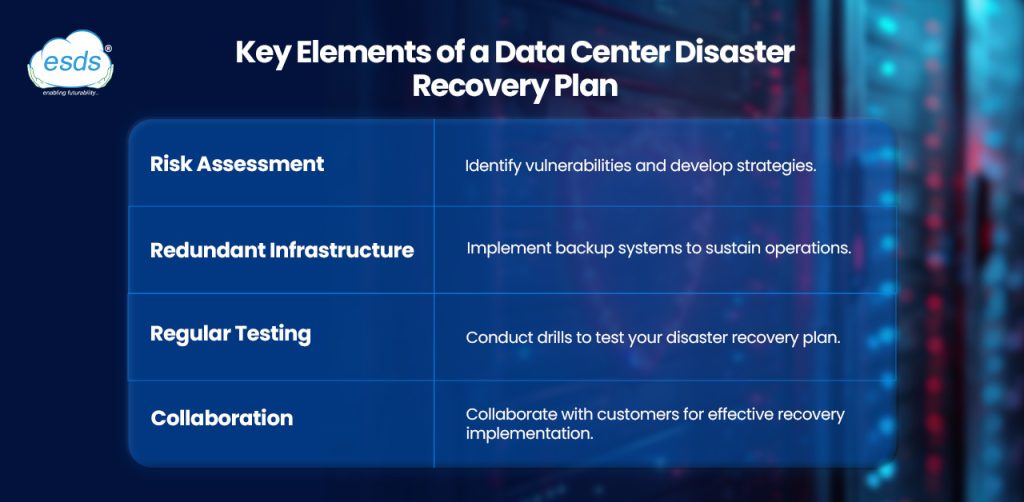
  • Disaster Recovery Plans: A well-defined disaster recovery plan, including risk assessment, redundant infrastructure, and backup power generators, can minimize downtime and protect data.

The Role of ESDS in Ensuring Business Continuity

At ESDS, we understand the importance of safeguarding your data and ensuring uninterrupted operations. Our state-of-the-art data centers are designed with resilience in mind, incorporating advanced fire suppression systems, redundant power supplies, and robust disaster recovery protocols. We also offer comprehensive disaster recovery as a service (DRaaS) to help businesses quickly restore operations during a catastrophic event.

Staying Ahead of the Curve

Disaster recovery plans are not static documents but living frameworks that must evolve with your business and technology. Krista Shepard of Cologix aptly said, “It’s important to periodically update and refine disaster recovery plans as your business and technology evolve and to adapt to changing environmental and weather conditions.”

At ESDS, we are committed to helping businesses stay ahead of the curve by providing cutting-edge solutions and expert guidance. Whether you want to enhance your data center’s resilience or develop a comprehensive disaster recovery plan, we’ve got you covered.

Conclusion

Datacenter fires may be rare, but their potential impact is too significant to ignore. By learning from past incidents, investing in infrastructure safety, and implementing robust disaster recovery plans, businesses can protect their operations, safeguard their customers’ trust, and ensure long-term success.


ESDS delivers secure, scalable, and resilient data center solutions tailored to your business needs. From disaster recovery as a service (DRaaS) to advanced fire suppression systems, our cutting-edge technologies ensure your data is always protected. Partner with ESDS to build a future-proof infrastructure that guarantees business continuity, no matter what challenges arise.

Contact us today to learn how we can help you stay ahead in an ever-evolving digital landscape.

How Data Centers in 2025 Will Solve the World’s Energy Crisis Without Sacrificing Performance

In the context of an unfolding energy crisis, data centres stand out as both part of the challenge and part of the solution. The transformation of services over the internet via cloud computing, IoT devices, AI, and big data analytics has increased the need for important data center resources exponentially. However, this development comes with a great drawback: energy usage.

Data centers are said to consume between 1-2% of the global electricity shares, and these figures are said to go up sharply with the increasing pace of digitalization. In India alone, “the sector spent close to 2.5 TWh of electricity in 2023, a number that is predicted to reach 5 TWh by 2025 during the transition phase.” With growing apprehensions about the impact of activities on the environment, data center service providers are adopting advanced technologies to optimize their efficiency and energy consumption at the same time.

The Energy Dilemma of Data Centers

Modern data centers house thousands of servers, cooling systems, and auxiliary equipment, operating 24/7 to support global digital needs. This continuous operation translates to massive energy requirements. According to a 2023 study, global data centers consumed around 340 TWh, contributing significantly to carbon emissions. This energy-intensive nature raises questions about their sustainability.

In India, the scenario is equally pressing. With the country poised to become a global digital hub, the data center sector is projected to reach a staggering 10 TWh in energy consumption by 2030. This increase underscores the urgent need for innovative energy management and greener practices.

The 2025 Revolution: Green and Smart Data Centers

The future of data centers lies in a combination of sustainability and advanced technology. Here’s how data center providers are addressing the energy challenge without compromising on performance:

1. Integration of Renewable Energy Sources

Data center operators are increasingly turning to renewable energy solutions, including solar, wind, and hydroelectric power, to reduce reliance on fossil fuels. Globally, the shift toward green energy has gained momentum, with renewable sources expected to combine a significant portion of the power mix by 2028.

Now India is taking significant actions. A substantial percentage of new data centers are being designed to run on renewable energy, aided by government incentives and corporate sustainability goals. This transition not only reduces emissions but also stabilizes operational costs by mitigating exposure to volatile energy prices.

2. Advanced Cooling Technologies

Cooling systems are among the largest energy consumers in data centers. Traditional air-conditioning systems are being replaced by more efficient alternatives like liquid cooling and free-air cooling. These methods use advanced designs to maintain optimal temperatures with minimal energy consumption.

Innovative cooling solutions are particularly critical in India, where high ambient temperatures pose unique challenges. Energy-efficient cooling not only supports sustainability goals but also ensures the reliability of data center servers, which are sensitive to temperature fluctuations.

3. AI-Powered Energy Optimization

Machine learning and AI now make it possible to optimize data center management through anticipating maintenance on systems, resource placement, and energy use management in real time. Smart AI systems can switch off unnecessary workloads, dormat servers during non-usage periods, etc., as well as keep monitoring and controlling Power Usage Effectiveness (PUE) metrics.

For instance, machine learning-based cooling models are able to estimate the server load cooling demand in terms of external temperatures and utilize energy sources smartly with assurance that the system power will be where it should be.

Ensuring Security and Scalability

While addressing energy concerns, data center service providers must also prioritize data center security and scalability to meet the growing demands of digital ecosystems. Advanced technologies such as zero-trust security frameworks, edge computing, and modular data centers are enabling providers to deliver seamless, secure, and scalable solutions.

Enhanced Security Measures

With the proliferation of cyber threats, data center management companies are investing heavily in multi-layered security protocols, including AI-driven threat detection, encryption, and physical access controls. These measures ensure the protection of critical data while minimizing downtime and energy waste caused by potential breaches.

Modular Data Centers

Modular designs allow for incremental expansion, reducing upfront energy costs and ensuring that capacity grows in line with demand. This flexibility makes modular setups an attractive option for top data centers in India, where rapid scalability is crucial.

India’s Path to Sustainable Data Centers

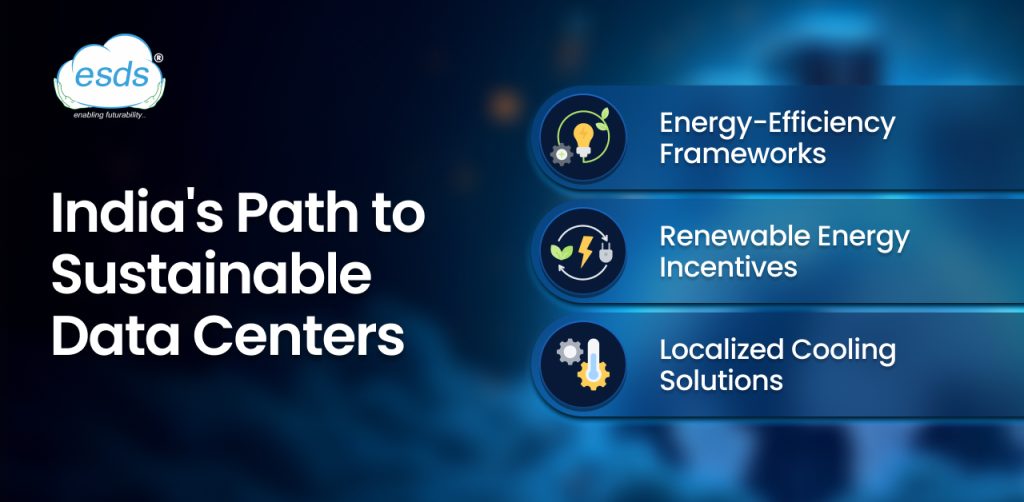
India’s growing data center market offers immense opportunities for growth, but sustainability must remain at the forefront. The government, along with industry stakeholders, has introduced several initiatives to promote greener practices:

•             Energy-Efficiency Frameworks: Collaborations between research institutions and industry bodies have led to the development of best practices for energy-efficient data center management.

•             Renewable Energy Incentives: Policies promoting solar and wind energy adoption are driving the green transition for data center services in India.

•             Localized Cooling Solutions: Advanced cooling technologies tailored for Indian climatic conditions are gaining traction, enabling both cost and energy savings.

The Road Ahead

By 2025, the convergence of renewable energy, AI-driven optimization, and advanced cooling technologies will redefine the way datacenter providers operate. These advancements will enable data centers to meet the growing demand for digital services while mitigating their environmental impact.

India’s data center industry, with its rapid growth and increasing focus on sustainability, is well-positioned to lead this transformation. As top data centers in India embrace these innovations, they will not only contribute to solving the world’s energy crisis but also set benchmarks for responsible and efficient operations.

In a world increasingly dependent on digital infrastructure, the dual goals of performance and sustainability are no longer mutually exclusive. With smart investments and a forward-looking approach, data center services can pave the way for a greener, more connected future.

ESDS: Pioneering Sustainable Data Center Solutions

At the forefront of this revolution is ESDS Software Solutions Ltd., a trusted name in the industry renowned for offering innovative and sustainable data center services. With a commitment to delivering high-performance data center servers and advanced cooling systems, ESDS is setting new benchmarks for efficiency and reliability.

ESDS is not just a leader in technology but also a pioneer in environmental responsibility. By integrating renewable energy sources and cutting-edge energy optimization techniques, ESDS ensures that its data center services in India align with global sustainability goals.

Whether you are a growing business or an established corporation, ESDS provides secure, scalable, and energy-efficient solutions tailored to your needs. Partner with ESDS and experience how the right data center service providers can help your organization thrive in a sustainable digital ecosystem.

Choose ESDS. Innovate responsibly. Power the future.

Data Centers: The Engine Behind India’s Digital Revolution

In today’s tech-driven world, companies rely on digital systems, making data center services crucial. These centers form the backbone of our digital economy, letting businesses across sectors store, process, and handle data and information without a hitch. From top-notch security to cutting-edge management tools, data center providers in India are changing their approach to keep up with new needs.

Going digital doesn’t just boost economic growth in all industries. It also paves the way for better public services more social and financial inclusion higher productivity, and a more connected society. Experts predict India’s digital economy will hit about $1 trillion by 2025. The government has helped improve the business environment for data center operators and developers. They’ve done this by giving data centers infrastructure status and introducing the Draft Data Centre Policy in 2020.

Let’s take a closer look at what data center services involve, check out the top providers in India, and see how they play a key role in the digital world.

What Are Data Center Services?

Data center services cover a wide range of solutions to ensure smooth operation, protection, and oversight of data center infrastructure. These services include:

1. Colocation:

  • Allows companies to lease physical space in a data center for their IT equipment.
  • Provides flexibility and lets businesses control their hardware and software.
  • Makes sense for organizations that need critical hardware or have high-security needs

2. Managed Services:

  • It involves hiring outside help to take care of IT infrastructure upkeep.
  • Covers things like looking after servers, managing networks, and keeping an eye on security.
  • It helps cut down on running costs and frees up other resources within a company.

3. Cloud Services:

  • Provide computing resources like storage and processing power through the internet
  • Scalable and flexible to adapt dynamic needs.
  • Includes Infrastructure as a Service (IaaS), Platform as a Service (PaaS), and Software as a Service (SaaS).

4. Cybersecurity Solutions:

• Protection against cyber threats – hacking, malware, ransomware
• Firewall protection, intrusion detection, and data encryption features
• Play a key role in keeping sensitive information safe and businesses running

5. Network Connectivity:

• Ensure the transferring of data without failure at all times waste. High-speed network connections.
• Dedicated internet access, MPLS network, and SD-WAN solutions.
• Essentially, it is necessary for businesses with remote offices or global operations.

In India, adopting technologies like IoT, AI, and big data analytics has increased the demand for these services. Businesses require robust and scalable infrastructure. In such a situation, the role of companies involved in data center management is a must.

Data Center Services in India: An Overview

Data centers are booming worldwide, even with some challenges. India stands out in the APAC region, with the biggest data center capacity of about 950 MW. This beats major countries like Australia, Hong Kong SAR, Japan, Singapore, and Korea, as a CBRE report shows.

India’s set to grow the most in the region, adding around 850 MW from 2024 to 2026. This boom highlights India’s strong points in the data center field. For instance, low-cost land, skilled workers, good transport, and a steady power supply are drawing big investments from tech leaders. Microsoft, Google, and Amazon are building massive data centers in the country. India has become a global hotspot for data center services. Many companies are putting money into top-notch infrastructure. The country’s helpful policies, which allow more people to use the internet, and a growing digital economy are pushing this sector forward.

Key Features of Data Center Services in India:

  1. Cost Efficiency: Affordable solutions tailored to meet diverse business needs.
  2. Strategic Locations: Data centers located in regions with low latency and high connectivity.
  3. Green Initiatives: energy-efficient technology adoption to reduce carbon footprint.
  4. Compliance and Standards: Observance of international standards such as ISO 27001 and GDPR.

Top Data Center Management Companies in India

There are numerous data center management companies in India offering top-notch services. The companies ensure the facilities are operational, minimize downtime, and deliver maximized performance. 

The best among them is:

  1. ESDS: A Pioneer in the Indian Data Centre Industry, ESDS offers a one-stop-shop solution for cloud, IT security, and managed services. With security and reliability as top priorities, ESDS enables businesses to undergo digital transformation.
  2. CtrlS: CtrlS stands for world-class data centers at global standards and offers excellent colocation and managed services. 
  3. Sify Technologies: Sify is also an Indian provider of data center and network services that offer cloud computing, cybersecurity, and disaster recovery, among several other solutions.
  4. Yotta: Yotta is India’s leading data center and cloud services provider that offers managed services, cybersecurity, and disaster recovery.
  5. Web Werks: One of the most influential players in the Indian data center market, offering reliable and scalable colocation and cloud services.

Importance of Data Center Security

With the rise in cyber threats, ensuring the security of data centers has become paramount. Data breaches can lead to severe financial and reputational damage, making security a top priority for service providers.

Key Components of Data Center Security:

  • Physical Security: biometric access controls, surveillance cameras, and secure perimeters.
  • Cybersecurity Measures: firewalls, intrusion detection systems, and regular vulnerability assessments.
  • Data encryption: protecting data both in transit and at rest.
  • Disaster Recovery Plans: Ensuring business continuity in case of disruptions.

Data center security involves protecting physical assets, safeguarding critical business information, and ensuring compliance with regulations.

Data Center Servers and Their Role

Servers form the core of any data center. They process data  , store applications , and manage the network traffic.

Advanced, high-powered data centers deploy advanced servers with cutting-edge processors, large amounts of storage, and efficient cooling to handle growing workloads.

Benefits of Advanced Data Center Servers:

  1. High Performance: Faster data processing and reduced latency.
  2. Scalability: ability to handle growing data volumes.
  3. Energy Efficiency: Reduced operational costs through optimized power usage.
  4. Reliability: minimizing downtime and ensuring continuous operations.

The Future of Data Center Services in India

With the help of future technologies combined with more digital adoption, the prospects of the data center service in India seem bright.  The key trends influencing the data center industry are:

  • Edge Computing: Processing data closer to the source to reduce latency.
  • Artificial Intelligence and Machine Learning: Leveraging AI and ML to optimize data center operations.
  • Sustainability: Pursuing green practices to minimize environmental footprint.
  • 5G and IoT: supporting the growth of connected devices and real-time applications.

Conclusion

While data centers will remain a concentrated industry in tier-I locations, the market has observed a significant move, with most colocation and edge computing facilities entering tier-II and tier-3 cities. The understanding behind this expansion is to be closer to their customers, provide faster response times, lower latency for applications requiring it, and decentralize DC infrastructure to effectively cover a distributed user base in India.
Cities such as Kochi, Jaipur, Ahmedabad, Lucknow, Patna, and Vishakhapatnam are emerging due to their strategic positioning and better infrastructure, particularly in power supply and improvements in fiber and cable connectivity. 

The Indian data center sector is likely to witness significant growth over the next couple of years, with increasing stakeholder focus on Tier II and III cities, sustained occupier interest, a growing talent base, and the strengths of the country as a hub for technology, R&D, and shared service platforms.  This will help boost capacity expansion in the country and increase India’s standing as one of the world’s premier global hubs for data centers, a place for innovation, and a potential source of huge international investment.
The rise of the digital economy has made the role of the data center even more crucial. 

Data centers’ task at hand is to ensure safe security and innovative management solutions, and Indian service providers have been on the leading edge of this change. Companies like ESDS are first in line with advanced infrastructure, a customer-centric approach, and a sustainable commitment.
Whether you are a small business or a large enterprise, you should take your success with reliable data center services in today’s digital-first world. You can, therefore, be sure that your data management needs are in good hands with ESDS as your partner.

Navigating the Future: The Evolution of Edge Data Centers in 2024

In today’s dynamic technological realm, the relentless quest for efficiency, speed, and accessibility has instigated a profound shift. No longer confined to centralized repositories, data now traverses a dispersed landscape, elevating the need for edge data centers. As we embrace the advent of 2024, these centers emerge as vanguards of innovation, fundamentally transforming our approach to comprehending and harnessing data. The traditional paradigm of centralized data centers, once the centers of information storage and processing, encountered limitations in meeting the escalating demands for instantaneous access and reduced inactivity. Consequently, the concept of edge data centers was conceived, offering a solution by redefining the geographical proximity of data to end-users.

Evolution of Edge Data Centers in 2024

In this epoch, data isn’t merely a static entity stored in distant silos. Instead, it flows dynamically, residing closer to where it’s utilized, thereby enhancing response times and facilitating real-time interactions. This evolution signifies a paradigmatic departure from the conventional model of data accessibility. The significance of edge data centers transcends mere convenience; it embodies a seismic shift in the very essence of data utilization. These centers empower applications that demand instantaneous responsiveness, revolutionizing industries and enabling innovations that were once constrained by latency and geographical distance.

As we advance into 2024, these centers are no longer peripheral players but pivotal hubs orchestrating a symphony of seamless connectivity. They stand resolutely at the nexus of innovation, reshaping the fundamental tenets of how we process, disseminate, and leverage data in an era where distance and efficiency reign supreme.

The Genesis of Edge Data Centers

Traditionally, data centers were concentrated, serving vast regions and populations from centralized locations. However, the burgeoning need for low-latency, high-bandwidth applications demanded a shift in approach. Enter the concept of edge data centers – strategically positioned facilities designed to bring data closer to the end-users.

The Transformative Shift

The evolution of edge data centers in 2024 marks a transformative shift in the data landscape. These centers are no longer mere storage units but dynamic hubs that process and deliver information at lightning speed, enabling real-time applications like never before.

1. Proximity to Users

Edge data centers in 2024 prioritize proximity. By dispersing these centers closer to the consumers, the latency is significantly reduced, facilitating seamless experiences for applications demanding immediate responses, such as IoT devices, autonomous vehicles, and augmented reality.

2. Enhanced Security Measures

Security remains paramount. Edge data centers have evolved to fortify themselves against potential threats. With advanced encryption protocols, multi-factor authentication, and robust firewalls, these centers ensure data privacy and protection without compromising on speed.

3. AI and Automation Integration

2024’s edge data centers aren’t just about hardware; they’re also the nerve centers of sophisticated AI and automation. These technologies optimize operations, predict system anomalies, and adapt to changing demands, making them more agile and efficient.

The Impact on Industries

The ripple effects of edge data centers extend across various industries, fundamentally altering how businesses operate and how consumers experience services.

1. Healthcare

In the healthcare sector, edge data centers revolutionize patient care. Real-time data analysis enables quicker diagnosis, remote monitoring, and personalized treatment plans. This advancement not only enhances patient outcomes but also improves overall healthcare accessibility.

2. Retail

For the retail industry, edge data centers redefine the shopping experience. From personalized recommendations based on in-store movements to efficient inventory management, these centers empower retailers to create immersive, responsive, and seamless customer interactions.

3. Entertainment and Gaming

Entertainment and gaming industries witness a paradigm shift with edge data centers. The reduction in latency ensures immersive gaming experiences and seamless streaming of high-definition content, bringing entertainment closer to users in an unprecedented manner.

Challenges and Future Prospects

While the evolution of edge data centers brings about remarkable advancements, challenges persist. The deployment and maintenance of a distributed network demand substantial investments. Additionally, ensuring uniformity in service quality across diverse geographical locations remains a hurdle. However, looking ahead, the future seems promising. Technological advancements such as 5G networks, quantum computing, and advancements in data processing hold the potential to overcome these challenges, further propelling the capabilities and reach of edge data centers.

Conclusion:

Embracing the Edge As we navigate the future, the evolution of edge data centers in 2024 signifies a pivotal moment in our technological journey. It’s not merely about storing or processing data; it’s about empowering innovation, transforming industries, and bringing us closer to a hyper-connected world. The road ahead is paved with opportunities and challenges, but it’s evident that edge data centers are the cornerstone of this technological revolution, reshaping our digital landscape and propelling us into a future where speed, accessibility, and efficiency are the norm

Datacenter Security in the Age of Cyber War

Data centers are essential to the global economy’s future.

Certainly, as more people and organizations migrate to the digital realm, the demand for efficient information processing grows. Data centers serve as communication networks even remotely, enabling end users to access information quickly.

Data centers are more important than ever at a time when remote working environments are expanding and becoming more common.

Data centers are much more than they appear. They are central to a digital transformation movement.

The global data center market is expected to reach $105.6 billion by 2026.

The expansion of data centers shows no signs of reducing. On the contrary, there is an increasing demand for greater digital data access, processing, and storage.

Global Data Center Market

Understandably, the combination of remote working trends and a tech-savvy culture indicates that the data center market size will continue to grow indefinitely.

Growth, however, has its challenges.

One of the most significant barriers facing data center expansion is how the sector can comprehend to manage its security issues.

Data security concerns 76% of business data centers.

Data security is the company’s first worry, as it can expose enterprises to unintended data loss, corruption, and exposure. However, security solutions can be time- and money-consuming for data centers that handle vast amounts of data.

Simply put, assume you have million dollars & you are responsible for safeguarding them. Would you leave it open for criminals to steal or lock it away?

This parallel applies to your data center, a virtual goldmine of information. Still, many businesses prefer to do the bare minimum regarding data center security. The data center of your organization, which consists of connected computers, servers, and devices that process, distribute, and store valuable information, is an integral part of its digital infrastructure. The mix of policies, methods, procedures, and technology that protect data centers from cyber attacks and other virtual dangers is known as data center security.

So, what data security standards should you be aware of to meet and maintain compliance?

Let’s talk about it.

Firstly what data can be found in the data center, and how can the data be exposed?

It should be no surprise that data security is critical for any business. It’s priceless information that can make or extinguish your business. Examples of data contained in a data center include proprietary information like intellectual property and trade secrets, as well as personal and financial information from clients.

  • Customer trust and reputational harm: Why should your customers trust you if they know you aren’t protecting their data (or even your intellectual property)?
  • Noncompliance fines from industry rules: PCI DSS, HIPAA, GDPR, SAE 18 (previously SAE 16), and ISO 27001: 2013 are among the regulations that have data center security standards.
  • Financial losses and revenue loss: Organizations are concerned about downtime because it could result in large revenue losses.

Tip for Datacenter Security in the Age of Cyber War

Datacenter Security

Tip #1: Data Center Security at Physical Level

When people evaluate the security mechanisms to secure their organization’s data, they often overlook the physical security aspect. Why? They are frequently focused on concerns about data loss hazards caused by cyber assaults and data breaches.

Businesses may need to realize that physical security threats can be among the most damaging.

If you’re building your own data center rather than using a cloud or colocation data center, it’s critical to plan out the physical space of your data center ahead of time. This includes selecting if your data center should be in a remote location or in a more crowded area.

But, in terms of security, what else should you consider when choosing a location for a data center? Keep an eye out for weather-related hazards and low-lying places. Keep an eye out for heated geological zones that are prone to earthquakes.

If you intend to build in a more densely populated region, you can conceal your data center by making it blend in with its surroundings.

Physical Security Measures for Data Centers

Aside from the location, there are numerous other physical security concerns. Datacenter hardening can comprise the following measures:

  1. Walls and structures made of reinforced concrete can defend the facility from external attacks.
  2. Server cabinets and cages that are anchored to the ground and locked.

3. Temperature and humidity variations are monitored and regulated via environmental controls.

Tip #2: Invest in the Right Tools to Protect Your Data and Network

Traditionally a solid data center security plan employed perimeter-based security solutions to monitor and protect your network from both internal and external threats. But, nothing is constant in security, and this is especially true when it comes to the basic approach and model that many firms are adopting.

Zero Trust cybersecurity is a term that isn’t necessarily new but has become increasingly relevant as a result of the COVID-19 outbreak. Zero Trust solutions are quickly becoming the norm for remote and scattered employees. The concept is that no person or device, whether inside or outside the system, should be automatically trusted.

If you wish to harden your data center’s cyber security even more, you can (and should):

  • Audit your assets, security management processes, and access protocols regularly.
  • You can protect data between endpoints via network encryption and on the server by using server-level encryption.
  • To continuously monitor logs and report on security events and threats, integrate automation and security information and event management (SIEM) solutions (or use a third-party service).

Tip #3:  Monitor and Restrict Physical & Virtual Access

However, more than having door locks and cameras are needed to secure your data. It would help if you also kept an eye on digital access. Why? According to IBM and the Ponemon Institute’s 2019 Cost of a Data Breach Report, 49% of data breaches were caused by human errors and system malfunctions rather than cyber attacks.

Tip #4: Have Redundant Data Backups and Infrastructure in Place

No matter how often we discuss data backups, more is needed. As you’ve read in the news, ransomware and cyber attacks have impacted major municipalities, hospitals, and companies. However, for some reason, organizations prefer to refrain from taking the necessary safeguards to create redundant data backups.

Is it due to laziness? Perhaps it’s the “it won’t happen to me” mentality. Regardless of the reasons why they shouldn’t, having redundant backups – both data and secondary infrastructure — in place can save you a lot of time, money, and problems. When the crap hits the fan — and it will, inevitably — you’ll wish you’d taken the time to prepare.

Tip #5: Keep Your Servers and Systems Updated

Nobody enjoys taking time out of their day to run tedious updates and patch their systems. After all, you have far more essential things to attend to, don’t you?

Keep your servers and systems updated

When manufacturers offer patches, it is their means of plugging any security holes found in their devices. It’s similar to fixing a hole in your roof to keep rain from spilling or leaking through. It’s their technique of patching the flaw before a lousy man can exploit it and cause problems.

Final Thought

Your network computers, servers, and other critical components are kept in your data center. In a calamity, it serves as a safe refuge for your data.

You have less control over the physical security measures in place if you consider hiring a cloud or managed hosting service provider than you would with an in-house data center. However, you can request compliance reports from the service provider, giving you more confidence in their security capabilities.