
How AI Colocation in India Handles Power & Cooling?

Artificial intelligence is moving from experimentation to production across Indian enterprises. Banks are deploying fraud detection models in real time. Manufacturers are running predictive maintenance systems. Healthcare platforms are training diagnostic algorithms on large datasets. As adoption accelerates, infrastructure constraints are becoming more visible.

Traditional enterprise racks built for moderate CPU workloads cannot sustain modern AI clusters. The conversation has therefore shifted toward AI colocation India strategies that can support high-density racks, accelerated compute, and sustained GPU utilisation. Designing a GPU data center is no longer a matter of incremental upgrades. It requires structural changes in power engineering, thermal management, and network architecture.

This article examines the three critical pillars of AI-ready colocation in India: power, cooling, and latency.

Understanding What “AI-Ready” Really Means

The term AI-ready is often used loosely. In technical terms, it refers to facilities engineered to support rack densities ranging from 30 kW to 80 kW or more. By contrast, conventional enterprise racks typically operate between 5 kW and 10 kW.

AI workloads rely heavily on accelerator platforms such as those produced by NVIDIA. These GPU-based systems are optimized for parallel processing and large-scale matrix computations. When deployed in clusters for model training, they operate at sustained high utilization levels, which significantly increases power draw and heat output.

An AI-ready colocation facility must therefore offer:

  • High-capacity electrical feeds
  • Advanced thermal management systems
  • Carrier-dense network connectivity
  • Scalable physical infrastructure

Without these elements, performance bottlenecks and operational risks quickly emerge.

Organisations evaluating how to choose a cloud GPU provider should examine similar factors, including sustained performance under load, redundancy models and scalability planning.

Power Architecture: The First Constraint

Power is the first engineering constraint in any AI colocation India deployment.

According to Gartner, global electricity demand for data centres is projected to increase 16 percent in 2025 and nearly double by 2030. AI-optimised servers are expected to account for a growing share of that demand, rising from approximately 21 percent of total data centre electricity consumption to around 44 percent by the end of the decade.

This surge reflects the transition toward GPU-intensive infrastructure worldwide, including India’s expanding digital economy.

For a deeper technical breakdown of how modern data centers power AI at scale, including power distribution design and GPU cluster engineering, refer to this detailed analysis on modern data centers’ power AI at scale.

Key Power Considerations for AI Colocation in India

  • High-capacity power feeds per rack
  • N+1 or 2N redundancy models
  • Lithium-ion UPS systems
  • Scalable switchgear design
  • Renewable power integration

Major data centre hubs such as Mumbai and Chennai provide strong connectivity and established infrastructure ecosystems. However, long-term power planning remains essential as AI deployments scale.

Cooling Strategies for High-Density Racks

As rack density increases, thermal management becomes critical.

Traditional air-cooling systems begin to lose efficiency beyond 20 kW per rack. High-density racks used in GPU data center environments require enhanced cooling architecture.

Modern Cooling Approaches

  • Hot aisle and cold aisle containment
  • Direct-to-chip liquid cooling
  • Rear door heat exchangers
  • Immersion cooling for ultra-high-density deployments

Cooling strategy must also account for India’s climatic diversity. Coastal regions experience higher humidity levels, while inland regions may face higher ambient temperatures. Facilities must be engineered accordingly.

Traditional vs AI High-Density Infrastructure

To better understand the infrastructure shift, consider the comparison below.

ParameterTraditional Enterprise RackAI High-Density Rack
Average Power Density5–10 kW30–80 kW+
Cooling MethodStandard air coolingLiquid-assisted or advanced containment
Workload TypeVirtual machines, ERP, storageGPU clusters, AI model training
Power RedundancyBasic N+1Enhanced N+1 or 2N
Thermal MonitoringStandardAdvanced real-time monitoring
Floor PlanningFixed layoutModular and scalable

This highlights why AI colocation India facilities must be purpose-built rather than adapted from legacy designs.

Latency and Network Architecture in Indian Metro Hubs

AI workloads have dual network requirements. Training workloads demand high internal bandwidth across GPU clusters. Inference workloads require ultra-low latency to users.

Proximity to network hubs significantly impacts performance. Mumbai serves as a major connectivity gateway due to subsea cable landings and dense carrier presence. Chennai also provides strong international bandwidth routes.

AI-ready colocation facilities should offer:

  • Carrier-neutral connectivity
  • Direct cloud interconnect
  • High-capacity fibre infrastructure
  • Low-latency routing within India

With the growth of 5G and edge deployments, inference nodes may increasingly require regional distribution.

Scalability and Modular Expansion

AI adoption rarely remains static. Organisations often begin with pilot clusters and scale quickly as models mature.

AI colocation India providers must support:

  • Modular power blocks
  • Expandable white space
  • Flexible rack layouts
  • High floor load tolerance

Planning for growth from the outset reduces long-term capital disruption.

Compliance and Data Sovereignty in India

Data governance is a defining factor in AI infrastructure planning.

Hosting AI workloads within India supports regulatory alignment and strengthens enterprise control over sensitive datasets. It also aligns with national initiatives such as Digital India.

Enterprises should evaluate:

  • Physical security controls
  • Access management systems
  • Network segmentation
  • Audit readiness
  • Industry certifications

For regulated industries, data sovereignty is not optional. It is an architectural requirement.

For a detailed perspective on why data sovereignty matters in cloud infrastructure and how it impacts regulated industries, this analysis offers a comprehensive framework.

Why Enterprises Are Choosing AI-Focused Colocation

Building a private GPU data center requires substantial capital expenditure and long deployment timelines. AI-ready colocation reduces these barriers.

Providers such as ESDS Software Solution Limited offer enterprise-grade colocation data centre services designed for high-density racks and mission-critical workloads. By leveraging established infrastructure, organisations can focus on AI innovation rather than facility management.

The shift toward AI colocation in India solutions allows enterprises to:

• Reduce upfront capital investment
• Accelerate deployment timelines
• Improve operational resilience
• Maintain compliance within Indian jurisdiction

Conclusion: Building Future-Ready AI Infrastructure in India

AI infrastructure is redefining the Indian data centre ecosystem. Rising electricity demand forecasts underscore the scale of change. GPU-intensive workloads require more power, advanced cooling, resilient connectivity, and domestic compliance alignment.

High-density racks are no longer niche deployments. They are becoming foundational to enterprise AI strategy. Organisations that adopt AI-ready colocation in India today will be positioned to scale confidently as computational demands grow. To design a sovereign and scalable AI environment, explore the detailed framework in the
Sovereign AI Infrastructure Blueprint: How to Build It Right

Why Indian Enterprises Are Adopting Database Colocation?

In 2026, Indian enterprises across sectors such as banking and financial services, healthcare, manufacturing, e-commerce, and government services are reassessing how critical databases are hosted and managed. As data volumes increase and regulatory expectations continue to evolve, organizations are evaluating database colocation in India as part of long-term infrastructure and risk management planning.

This article presents a general industry perspective on the factors influencing this shift. The content is informational in nature and focuses on commonly observed enterprise IT considerations related to secure DB hosting, colocation for databases, and Tier 3 database infrastructure.

Overview of Database Colocation in India

Database colocation in India refers to the deployment of enterprise-owned database servers within third-party data centers located in India. In this model, the data center operator provides physical infrastructure such as power, cooling, space, and security, while enterprises retain ownership and control over database hardware, software, and data.

This approach is commonly evaluated by organizations seeking secure DB hosting while maintaining governance over critical workloads.

1. Preference for Tier 3 Database Infrastructure

Enterprise databases often require infrastructure that supports high availability and controlled maintenance. Tier 3 database infrastructure is designed with redundant power and cooling paths, enabling maintenance activities without full system downtime.

As database workloads increasingly support real-time operations, analytics, and customer-facing applications, Tier 3-aligned facilities are frequently considered during colocation assessments.

2. Structured Physical and Environmental Security Controls

Colocation facilities are purpose-built to provide controlled physical environments. For enterprises hosting sensitive or regulated databases, such facilities typically include:

  • Multi-layer physical access controls
  • Continuous surveillance and monitoring
  • Fire detection and suppression systems
  • Environmental controls for temperature and humidity

These features are relevant for organizations evaluating secure DB hosting options aligned with internal governance and audit frameworks.

3. Infrastructure Cost Rationalization

Building and maintaining private data center facilities require substantial capital investment and ongoing operational expenditure. Colocation for databases allows enterprises to deploy existing or new hardware within shared facilities, potentially improving cost predictability while avoiding large infrastructure build-outs.

This model is often reviewed as part of broader IT cost and capacity planning initiatives.

4. Data Residency and Regulatory Alignment

India’s regulatory environment places increasing emphasis on data residency and sector-specific compliance requirements, particularly for financial services, healthcare, and public sector organizations. Hosting databases within Indian colocation facilities may support alignment with applicable regulatory expectations, subject to interpretation and compliance assessments.

As a result, database colocation India has become a relevant consideration in regulatory risk planning.

5. Geographic Proximity and Network Connectivity

Colocation facilities in India are commonly located in established data center hubs such as Mumbai, Bengaluru, and other strategic regions. Proximity to network exchanges and enterprise user bases can support improved connectivity and latency performance for database-driven applications.

These geographic factors are evaluated by enterprises operating latency-sensitive workloads.

6. Scalability for Growing Database Workloads

Database requirements may evolve due to business expansion, digital transformation initiatives, or analytics adoption. Colocation environments typically allow incremental scaling through additional rack space, power capacity, or interconnect options without major infrastructure redesign.

This flexibility is relevant for organizations planning medium- to long-term database growth.

7. Availability of Infrastructure Support Services

Colocation providers generally offer infrastructure-level support services such as monitoring, incident response, and on-site technical assistance. These services can complement internal IT operations and support continuity objectives for database environments.

Such arrangements are evaluated based on organizational operating models and internal capability.

8. Colocation Within Broader Infrastructure Strategy

Colocation for databases is increasingly evaluated alongside broader cloud and infrastructure strategies rather than as an isolated deployment decision. Enterprises are aligning physical infrastructure choices with hybrid and multi-cloud architectures to balance control, scalability, and performance.

Further context on how infrastructure strategies are evolving is discussed in cloud infrastructure trends shaping enterprise IT in 2026, which outlines developments influencing long-term technology planning.

9. Database Migration and Hosting Model Considerations

As enterprises evaluate hosting models such as on-premises infrastructure, colocation, and managed database platforms, migration readiness becomes an important consideration. Technology leaders typically assess architectural dependencies, governance requirements, and operational risks before transitioning workloads.

A structured view of this evaluation process is outlined in critical DBaaS migration questions for CTOs, which highlights commonly reviewed factors prior to database migration initiatives.

10. Secure DB Hosting and Data Governance

Secure DB hosting involves both infrastructure-level controls and enterprise-led governance over access, configurations, and data usage. Organizations increasingly assess how data sovereignty and jurisdictional considerations influence database deployment decisions, particularly in hybrid and cloud-integrated environments.

This perspective is further discussed in why data sovereignty matters for cloud security, which explores governance considerations relevant to secure data hosting.

ESDS Colocation Data Centre Services: Infrastructure Overview

ESDS is an India-based technology services provider that offers colocation data centre services across multiple locations in India. These services are designed to support enterprise infrastructure workloads, including databases, within controlled data center environments.

Key Infrastructure and Service Features

  1. Tier III–designed data center facilities located in Nashik, Navi Mumbai, Bengaluru, and Mohali
  2. Redundant power and cooling design principles
  3. Rack-level and cage-level colocation options
  4. Physical security controls and monitored access
  5. Infrastructure support and remote hands services
  6. Energy-efficiency and sustainability-oriented data center practices

The inclusion of this information is for general awareness and does not constitute a recommendation or assurance of service outcomes.

Conclusion

The increasing adoption of colocation for databases by Indian enterprises in 2026 reflects broader considerations related to infrastructure resilience, regulatory alignment, scalability, and operational efficiency. As database workloads become central to business operations, colocation facilities in India are being evaluated as part of long-term IT and risk management strategies.

Enterprises are advised to conduct independent technical, legal, and compliance assessments before selecting colocation or database hosting models.

Colocation vs Cloud: What Works Better for BFSI in 2025

Colocation vs Cloud: What Works Better for BFSI in 2025

Whether cloud or Colocation is the best option for your company, one thing is certain: the last few years have shown the critical relevance of dependable data upkeep. Increased reliance on remote labor, increased frequency of natural disasters, and an increase in cybersecurity attacks have all shown that organizations require dependable data centers. Cloud computing is generally the first option that springs to mind. However, Colocation or hybrid environments may be a better fit for your requirements.

We’ll undertake a side-by-side comparison of cloud and Colocation to help you decide which option is best for you.

What is Cloud Computing?

Cloud computing is the transmission of computer services via the internet, allowing users to access cloud-based software, applications, resources, and storage from any compatible and allowed device and location. When employing a third-party cloud provider, enterprises are not required to invest in or manage on-premises infrastructure or hardware because the provider manages all investments, maintenance, and day-to-day operations.

Types of Cloud Computing

Businesses that use cloud hosting to manage their data can choose between public, private, hybrid, and multi-cloud.

Public cloud services are an affordable cloud option for enterprises that do not want to maintain, purchase, or operate on-premises physical gear.

A private cloud can be an on-premises solution or managed by a third-party provider, and it can be housed nearby to your office or near clients. It’s beneficial for businesses who require greater control over their workloads and legacy apps that cannot be transferred to the public cloud.

Hybrid solutions combine cloud and non-cloud infrastructure. This can be beneficial for organizations with legacy workloads that are too difficult to migrate or firms with demanding and complex compliance requirements for part of their workloads.

Benefits and Drawbacks of Using Cloud Computing

Cloud computing comes with benefits, including: –

  • Increased cost-effectiveness in infrastructure, real estate, and maintenance expenditures.
  • Improved time to market.
  • Scalability to meet the expanding needs of enterprises.
  • Increased productivity and performance, allowing your IT resources to handle other responsibilities.
  • More security and disaster recovery protection in the cloud, especially when working with a cloud provider that offers extra managed services.

However, there are some limitations to cloud computing.  If your apps are overly reliant on one vendor, you may encounter vendor lock-in, making switching to another cloud provider expensive or time-consuming.  While public cloud providers meet the majority of major compliance criteria, they may fail to meet more specific regulatory norms.  In general, cloud computing allows for less customization than on-premises frameworks or Colocation.

What is Colocation?

Colocation (commonly known as “colo”) enables your organization to run its own IT equipment in a third-party data center. When employing colocation services, the data centre’s responsibility is to offer a secure, reliable environment for the client’s hardware, whilst the user is responsible for maintaining and administering all of their own equipment.

With more traditional data centers closing, organizations are turning to colocation and cloud hosting services.

Types of Colocation Services

Colocation can be done wholesale, retail, or as a hybrid of both. Wholesale Colocation occurs when a corporation rents out space in a data center, such as a room or an entire cage. Larger organizations that need the space and resources are more likely to choose this choice. Retail Colocation is the rental of a cabinet or rack in a data center. It is a more scalable choice for smaller organizations that do not require as much power and resources.

Benefits and Drawbacks of Using Colocation

Colocation benefits include: –

  • Saving on on-premises data center real estate costs.
  • Improved disaster recovery and physical security because it is located in a provider’s secure data center.
  • The ability to scale without having to consider relocating buildings or constructing new structures.
  • Cost reductions via energy and facility management.
  • Increased connectivity choices when compared to an on-premises data center.

Colocation services, if not used to their maximum capacity, might be more expensive than cloud computing due to the cost of a dedicated room or area as well as capital expenditures (CapEx) for physical equipment. Colocation is more adaptable than the cloud, but less so than on-premises infrastructure.

Cloud Vs. Colocation: Business Considerations

When to Use Cloud Computing

If you don’t already have your own gear, want to get up and running quickly, and want to work with experts to set things up with a cloud service provider, cloud computing is an excellent alternative. Small or highly variable workloads that need to scale are also ideal for the cloud.

When to Use Colocation

Colocation can facilitate the shift from old workloads, improve disaster recovery readiness, and enable hybrid deployment. It’s a versatile solution with a diverse set of services and physical features suitable for practically any organization.

Legacy workloads are not always ready for the cloud right once, either because equipment contracts have not yet ended, extra development is required, or for other reasons. Moving to a colocation facility is a positive step that does not require any substantial changes right away.

Key Considerations for Using Cloud and Colocation for BFSI

Here are the key considerations for using cloud and Colocation for BFSI includes: –

Key Considerations for Using Cloud and Colocation for BFSI
  • Agility meets Scalability

Cloud computing has redefined infrastructure agility. For BFSI institutions, the ability to spin up new environments, launch services quickly, and handle spikes in user activity makes the cloud appealing. Whether it’s digital onboarding, real-time analytics, or fraud detection, the cloud’s elastic Scalability and OpEx model suit modern application workloads.

  • Power of Control & Customization

Despite the cloud’s advantages, Colocation still offers critical value for BFSI. With Colocation, financial institutions retain greater control over hardware, compliance measures, and physical security. Applications that require low latency—like core banking systems and high-frequency trading platforms—thrive in colocation environments. In fact, for many data-sensitive and compliance-heavy workloads, colocation BFSI models are preferred due to their predictable performance and regulatory alignment.

  • Data Sovereignty & RBI Norms

One of the biggest differences between cloud and Colocation in BFSI lies in compliance. RBI guidelines increasingly stress local data storage, sovereignty, and strict auditability. While cloud vendors offer compliance-ready solutions, Colocation often provides deeper visibility and control over data handling practices. In regulated environments, the debate on cloud vs. colocation banks leans in favor of Colocation, especially for sensitive customer data and core infrastructure.

Conclusion

The decision between cloud and Colocation is not about choosing one over the other. It’s about aligning infrastructure strategies with your organization’s unique business goals, compliance responsibilities, and technical demands. Cloud offers unmatched agility and Scalability, making it ideal for dynamic workloads and rapid innovation.

At ESDS, we understand the requirements for the BFSI sector. Our Tier-3 certified data centers colocation BFSI infrastructure, and complaint cloud hosting services are engineered to meet the highest standards of data security, performance, and uptime.

Let us know in the comment section below regarding the comparison between cloud and Colocation.

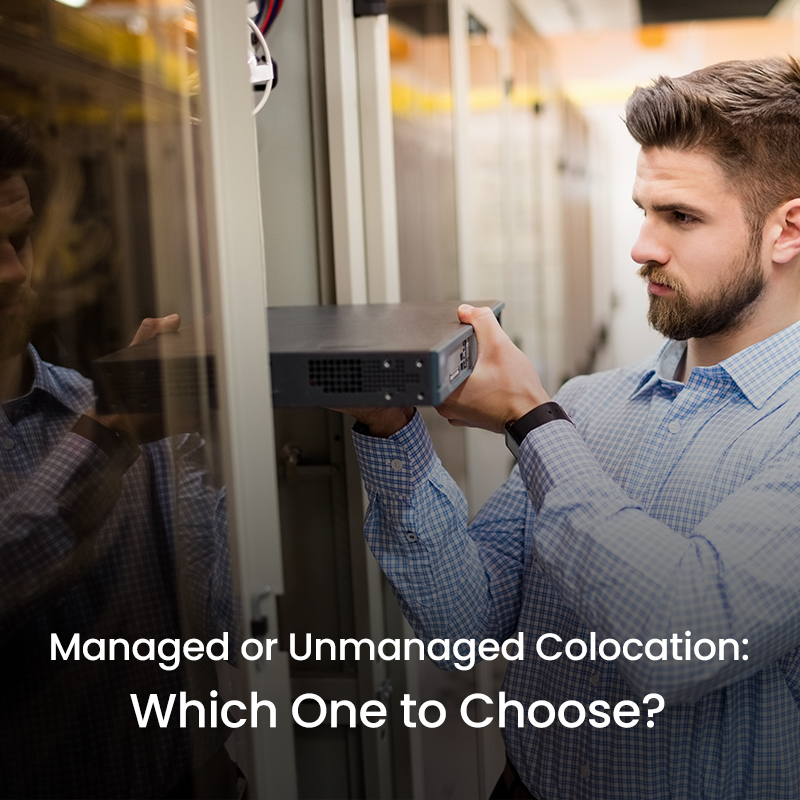
Managed or Unmanaged Colocation: Which One to Choose?

Managed or Unmanaged Colocation

As an end-user, if you have decided to opt for colocation hosting for your web servers, you need to determine the best colocation option for yourself. The first option is to physically take your machines to the colocation provider’s location and use their racks. At the same time, the second option could be renting out the server machines from the colocation provider. When you decide to take the machine to the provider’s location, it is usually termed Unmanaged Colocation. When you rent out server machines from the provider, it is known as Managed Colocation. Be it managed or unmanaged Colocation. They significantly impact a Data Center’s maintenance, pricing, processes, & applications that run on the servers residing in the Data Center.

What is Colocation?

Colocation or ‘Colo’ is the practice of leasing out server spaces and other computing hardware at the premises of a colocation services provider. Colocation services generally include a physical infrastructure where everything is present at one place comprising networking devices, physical security & other cooling components needed for supporting servers & storage offered by users. With a colocation hosting service in place, businesses have to share the costs related to hardware. Usually, some of the best colocation providers have the capability to store numerous servers, generators & uninterrupted power supply. Also, the providers are standardized with industry certifications, much like other hosting providers.

Benefits of Colocation Services

1. For a business of any size, colocation hosting services help them to save their initial infrastructure investments. The Colocation hosting infrastructure costs are shared amongst other enterprises that are availing the service of the colocation provider. Additionally, colocation hosting provides state-of-the-art services like robust security & redundant bandwidth to an end-user. Smaller enterprises can be benefitted from larger IT departments without incurring any huge expenses.

2. One of the financial benefits of colocation services is minimized downtime, and downtime for a few seconds could cause huge monetary losses. Through a scalable infrastructure & supporting resources such as bandwidth, diversified power sources, etc., colocation providers ensure near-zero downtime and smooth functioning of hardware even during physical disasters.

3. Colocation service providers ensure multiple layers of security are deployed through smarter mechanisms. Colocation Data Centers are strategically placed at a distance from the client’s on-site. Additionally, an on-site IT support team is kept for monitoring the security of technology assets. Colocation providers also offer industry-leading security mechanisms that allow easy restoration of physical & virtual data in case of losses or disasters.

4. With colocation hosting, businesses can guarantee that enterprises are easily able to handle traffic surges with ease. For this, colocation providers offer enhanced levels of bandwidth, while this spike in data is shared with other tenants present on the colocation server. This ultimately reduces the overhead bandwidth cost for an individual server tenant.

What is Colocation

What is Managed Colocation?

Managed Colocation is a bit different from traditional colocation hosting. In managed colocation hosting, the provider is responsible for managing a business’s IT infrastructure along with the physical hosting of these. Other managed services like security, backup, and storage are also offered in Managed Colocation services. Managed colocation hosting can be an ideal option for those who’re looking to retain their infrastructure with a certain level of expertise in server management. For smaller businesses, the biggest advantage of Managed Colocation is that it helps their costs in terms of physical space and the need for hiring IT expertise & infrastructure.

What is Unmanaged Colocation?

In an unmanaged colocation hosting costs related to housing & protection of servers are done by the colocation provider. Here, the end-user can directly benefit from the Data Center’s infrastructure, and however, the user is responsible if the server malfunctions. Unmanaged Colocation services vary from provider to provider, with one thing in common: providing a safe & secure passage for housing the servers. Unlike managed colocation hosting, the user has to perform all sorts of software upgrades, monitor configurations, patches, security & troubleshoot if any problem persists.

Colocation Data Center Industry Growth

The colocation Data Center industry is at a growing phase and has witnessed growth at a CAGR of 10.4% during the period Fiscal 2015 – Fiscal 2021. The industry has gained significant traction during the pandemic phase due to pent-up demand from different business verticals. The past few years have witnessed the emergence of several new players in India, resulting in increased supply. Several Government-led initiatives such as Draft Data Center Policy 2020, Data Localization policy have accelerated the demand for Data Centers in India.

Wrap Up

The final choice between managed and unmanaged Colocation should be carefully determined. CIOs and business heads must consult with their internal staff & experts regarding how much of the servers they wish to keep in-house. The decision should be made by keeping in mind the long-run benefits that the business aims to achieve.

Colocation Benefits – A simplified solution

Colocation hosting refers to the transfer of your IT infrastructure to a third-party data center. The data centers are extremely dependable, secure, and have a fully redundant infrastructure. Co-locating your web servers to a data center is always a good idea because it offers many advantages and provides a secure physical environment for your server.

Colocation web hosting provides all of the extra capabilities while also protecting data from natural calamities. Customers who have their own server can host it at a purpose-built Data Center, which is referred to as colocation (or Colocation Center). Customers pay for rack space in which to store their server while maintaining control over it.

There are numerous benefits which can be classified as follows:

Cost-effective

The colocation service is considered one of the cost-effective solutions for your servers to maintain. Basically, you don’t need to build and maintain the in-house requirements that your server demands can cost you valuable capital in facilities, Internet connectivity, and maintenance personnel. The colocation hosting providers have such kind of full facility available with their infrastructure.

Reliable Uptime

For server owners, uptime is always a big worry. With a colocation facility, one can rest assured that his server will be up and running at all times. Everything in a colocation center is redundant, so if something goes wrong, the colocation customers’ server and network equipment will be unaffected because redundant systems are in place to automatically replace the ones that went wrong.

Air conditioning systems, UPS (uninterruptible power systems), power generators, utility electricity, network routers, redundant Internet backbones with plenty of extra capacity, and redundant onsite network engineering employees are all examples of this.

More Security

Security is of prime importance when it comes to the servers or leasing any services for your IT equipment. Data centers are generally considered to be secured and well-established infrastructure. Data centers should be monitored 24-7. Your systems should be housed in a state-of-the-art data center, with redundant air cooling and filtering systems, designed to operate even in the event of a power failure. Data centers should be located and built to withstand natural disasters and other emergencies.

Network Speed & Reliability

Every server owner is concerned about getting good performance and dependability. The gear is designed to withstand both a climate-controlled environment and power conditioning. You can use server hosting to have access to enterprise-level backup and monitoring capabilities.

Many colocation service providers use BGP and have multiple Internet backbones and redundant Internet networks entering their facility. When a firm sets up a network at an office, they typically only receive the Internet bandwidth capacity that they require, such as a single T3, which is 45 megabits, or an OC3, which is 155 megabits, without redundancy.

Outage Protection

When deciding whether or not to move computers to a data center, power redundancy and backup are critical considerations. Power generators and backup power supplies are frequently used in colocation data centers to provide redundancy. This will allow networks to stay up even if there is a long-term power outage. Colocation providers frequently provide flood and fire protection for servers.