

Why Tier III Datacenters Are Now the BFSI Standard in India?

The Indian BFSI sector has been quietly reshaping its tech backbone over the last few years. Digital transactions are soaring, fraud patterns keep mutating, and regulators expect tighter control over everything—from uptime to data handling. With this constant pressure, financial institutions are rethinking where their core systems should live.
And one pattern stands out: Tier III datacenters are gradually becoming the default home for critical banking workloads.

If you look around, most of the heavy lifting—core banking, payments, settlement engines, regulatory reporting, even fraud analytics—now sits inside Tier III facilities. They’ve become the safe, sturdy middle ground the financial sector trusts.

So, why Tier III? Because BFSI wants an infrastructure that doesn’t flinch

1. Redundancy That Keeps Banking ALive

Tier III setups offer N+1 redundancy across power, cooling, and network pathways. It basically means there’s always a spare route, a spare system, a spare backup ready to kick in.
For BFSI, where even a 10-second outage can freeze an ATM network or disrupt UPI flows, that’s not a luxury—it’s oxygen.

You get:

  • Maintenance without shutdowns
  • Fewer single-point failures
  • A stable base for high-density workloads like fraud monitoring and transaction processing

No wonder many CIOs quietly agree that Tier III has become the “minimum acceptable” environment.

2. Matching India’s Regulatory Pulse

Banks and insurance players live under a microscope. Between RBI, IRDAI, and MeitY guidelines, the expectations are crystal clear:

  • Keep data within India
  • Maintain strict uptime
  • Track and control every access point
  • Ensure multi-zone protection
  • Maintain auditable, tamper-proof systems

Tier III datacenters naturally support this ecosystem with their structured zones, controlled access, predictable uptime, and environment stability. For BFSI teams, this reduces the maze of compliance overhead and lets them focus on improving services instead of babysitting infrastructure.

3. Fueling Digital Banking and AI-Heavy Workloads

Modern BFSI tech stacks aren’t simple anymore. You’ve got:

  • API-based banking
  • Digital onboarding
  • Real-time settlements
  • AI-driven fraud detection
  • Personalization engines
  • Cloud-native core banking upgrades

These workloads crave consistency—steady power, stable temperature, reliable hardware, and smooth performance under load. Tier III facilities offer all of that without wobbling.

As digital payments grow and fintechs push innovation faster, Tier III datacenters give BFSI teams the confidence that their infrastructure won’t become a bottleneck.

4. The Big Colocation Wave in Indian BFSI

There’s a noticeable shift happening: banks are moving away from running everything in-house. The cost, the manpower, the monitoring—it’s too heavy.
Colocation is filling that gap, especially inside Tier III environments.

Why? Because colocation offers:

  • Controlled capex with predictable opex
  • Space for high-density AI or analytics racks
  • Stronger security without expanding internal facilities
  • Faster rollout of digital products
  • Simplified disaster recovery designs

5. Security That Keeps Pace with Threats

Security sits at the center of every BFSI decision. Tier III datacenters bring multiple layers of defense:

  • Biometric access
  • 24×7 surveillance and SOC monitoring
  • Segregated network lanes
  • Compliance-ready logs
  • Fire suppression and climate-controlled zones
  • Redundant sites for Disaster Recovery

6. Cost Efficiency Because Standardization Works

One underrated perk of Tier III setups is cost discipline. When providers run at scale, customers naturally benefit.

BFSI clients get:

  • Shared power and cooling investments
  • Physical separation without huge infrastructure cost
  • Smaller internal teams needed for upkeep
  • Predictable pricing for compute and network

What offering does ESDS BFSI Community Cloud offers

ESDS provides BFSI Community cloud with regulation cloud environment built specifically for Indian banks, and also other financial institutions.

  1. Compliance & Sovereign – it satisfies data localization norms and regulatory mandates, giving institutions freedoms about data residency and audit readiness.
  2. Vertical auto-scaling & cost-efficient mode – Built on ESDS patented eNlight Cloud platform, the cloud can automatically scale compute and storage resources as demand fluctuates.
  3. End-to-End Services – From core banking systems to digital payment rails, regulatory reporting, document management, disaster recovery, and even newer services like AI-based analytics.
  4. GPU-as-a-service – ESDS’ GPU-as-a-Service (GPUaaS) platform provides banks, NBFCs and fintech players access to high-powered GPU clusters in a secure, compliant environment

ESDS BFSI Cloud bridges the gap between regulatory compliance, cost-sensitivity, and modern banking needs.

Wrapping it up

India’s BFSI ecosystem is standing at an interesting crossroads. Transaction volumes are rising, fraud is getting trickier, and digital infrastructure demands are climbing fast. In this setting, institutions need datacenters that stay solid—no matter how unpredictable things get.

Tier III facilities deliver that stability, which is why they’re rapidly becoming the go-to foundation for secure banking IT. And when paired with BFSI colocation and community cloud setups, the whole architecture becomes even stronger and more future-ready.

This shift isn’t just about tech. It’s a strategic move, one that sets the tone for how India’s financial sector will operate in the years ahead.

FAQs

1. Why is Tier III hosting preferred for BFSI?
Because it offers reliable N+1 redundancy, strong uptime, and compliance support. It fits mission-critical workloads like payments, core banking, and regulatory systems.

2. How does BFSI colocation help with regulations?
Tier III colocation providers support strict access controls, data localization, uptime commitments, and continuous monitoring.

3. What’s the purpose of a BFSI Community Cloud?
It gives banks and financial institutions a ready-made, policy-aligned environment for apps, data, and analytics. It also speeds up deployment and blends smoothly with Tier III setups.

4. Is Tier III suitable for analytics or AI-heavy banking workloads?
Tier III facilities handle high-density racks and deliver consistent power and compute performance, supporting fraud analytics, predictive models, and real-time engines.

5. How does Tier III strengthen secure banking IT?
Through layered physical security, network segregation, continuous monitoring, and redundant infrastructure—all designed to keep sensitive financial data safe and available.
Data Center Services for Growth Enhancing Scalability and Security

Data consumption has significantly increased due to the large increase in digital adoption across industries, which has strengthened India’s economic growth. The current economic boom shows how businesses are becoming more and more reliant on virtual solutions, which makes robust data centers necessary. Future growth in this need for data will drive advancements in the existing state of data infrastructure, which must address security, scalability, and performance issues brought on by today’s new workloads.

Data Center Market Growth Revenue in 2024

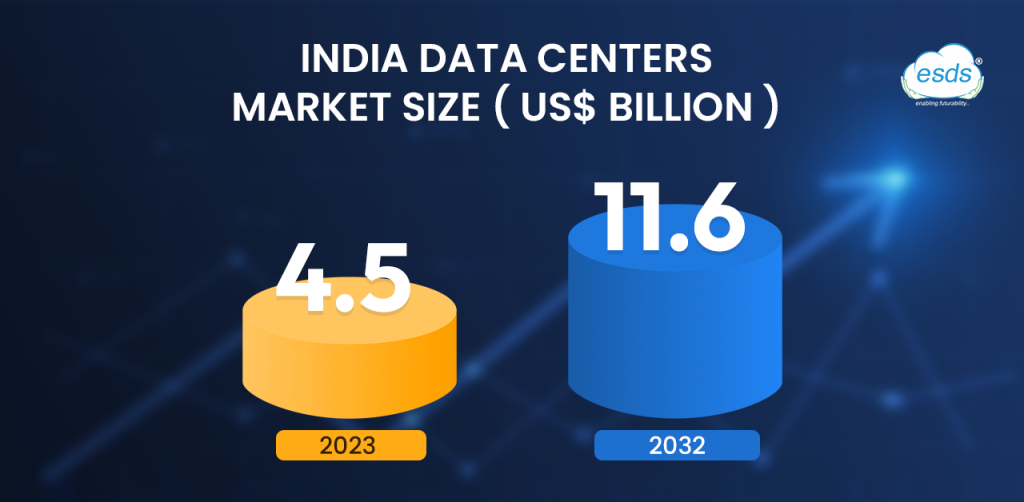
According to Statista, the data center business is predicted to earn $8.65 billion in sales by 2024.
The market is led by network infrastructure, which is estimated to reach $5.93 billion by 2024. Revenue is expected to rise at a compound annual growth rate (CAGR) of 6.50% by 2029, with a market volume of $11.85 billion. Globally, the United States will generate the majority of revenue (US$123.20 billion by 2024).

Overview of Data Center in India

In both developed and emerging nations, the data center sector has grown significantly. This is because businesses are becoming more ready to spend money on new infrastructure for data deployment and storage. In the age of digitalization, the data center industry in India is expanding rapidly. The country is well-positioned to become a global hub for data centers, especially those focused on cloud computing, and has a bright future ahead.

The top seven cities in India now have data centers with a combined capacity of 977 MW, according to a survey by Cushman & Wakefield. It is anticipated that India’s data center capacity will increase significantly in the future. By 2028, the capacity expansions now under development are predicted to reach 1.03 GW.

ESDS Major Player in the Indian Data Center Market

ESDS Colocation Services provides enterprises with cutting-edge data center capabilities, ensuring 99.995% uptime with 2N+1 redundant UPS systems and controlled diesel generators. Clients benefit from two Power Distribution Units for accurate monitoring and remote management via KVM-IP, as well as scalable power solutions ranging from 4KW to 40KW rack. Advanced safety features include precise air conditioning, VESDA smoke detection, and fire suppression. Additional advantages include no-cost installations, proactive monitoring, and performance assessments, which ensure ongoing peak performance and business continuity.

Cloud Integration: Enhancing Flexibility and Scalability

Cloud computing is revolutionizing the IT infrastructure of most businesses. It brings high-quality integration services to the data centers, allowing all organizations to connect their in-house systems with cloud environments simply. Integration services offered by these enable companies to be flexible in how they handle workloads and scale resources on demand without heavily investing in physical data center servers.

Hybrid clouds are currently becoming more prominent in the enterprise world simply because they offer the best of both worlds – namely, private and public clouds. This model provides an opportunity for enterprises to handle sensitive workloads on the private clouds while enjoying the economies and scalability benefits of public cloud resources. This integrated environment helps IT professionals reallocate workloads dynamically, optimize resource utilization, and, hence, enhance overall efficiency.

Data Center Security: Ensuring Protection and Compliance

As corporations increasingly store sensitive data, data center security is taking a huge chunk of focus. Data breaches, cyberattacks, and regulatory compliance are cited by C-level executives as the most significant reasons why data security remains pivotal in the management of a data center.

A better data center provider has a strict type of physical and digital security implementation to protect data and IT infrastructure. Physical would include general surveillance 24/7, biometric access controls, and also redundancy in power and cooling systems to ensure no downtime. The digital involves advanced firewall systems, intrusion detection, encryption, and continuous monitoring. Only these will quickly identify threats so that there is faster neutralization.

Any reliable data center provider must adhere to industry standards like ISO 27001, SOC 2, or GDPR. These requirements ensure that the operations of a data center are stringent regarding security and that their customer’s data is delivered with the utmost care. Besides, secured data transmission over the Internet and proper policies of network security always help to reduce the risks associated with cyberattacks or data breaches.

Colocation Services: Optimizing IT Infrastructure

One of the best solutions for organizations that want to reduce their capital expenditures without controlling their IT infrastructure is colocation services. Colocation allows companies to maintain their servers and all their associated hardware within a third-party data center, thereby enabling them to access world-class facilities devoid of the sunk costs or maintenance costs of a company’s data centers.

Colocation allows an organization to use the infrastructure of the data center, be it in the form of robust power supplies or cooling systems and high-speed network connections, while retaining ownership of its hardware. This approach also allows for the flexibility of growing up in response to changes within the needs of the business without requiring any other investment in physical space or resources.

Disaster Recovery Solutions: Safeguarding Business Continuity

Business continuity is aimed at recovery from unexpected disruptions, and disaster recovery services from data centers help protect organizations against data loss to help the business regain normalcy after a disaster.

Disaster recovery as a service encompasses strong solutions like automated backup, real-time replication, and geographic redundancy. Data centers adopt both recovery point objectives—which measure how much data could be lost if the failure happens—and recovery time objectives—which outline how quickly systems should recover to their operational power. These metrics determine that businesses will operate with minimum downtime, so the disasters will have little revenue impact and customer satisfaction.

Conclusion

Today, no business can afford to overlook robust data center services, be it cloud integration, data center security, colocation, or disaster recovery. It is thus advisable that businesses select a reliable data center provider and maintain agility, security, and resilience. A scalable, secure, and efficient IT infrastructure will be pivotal to growth in the not-too-distant future.

Find out how ESDS data centers in India are changing the game for business resilience and scalability with cloud integration, security, colocation, and disaster recovery solutions. India Ka Apna Cloud-powering, the cutting-edge technology offered by ESDS, gets to the very specific needs of Indian businesses: this uniquely catered requirement ensures compliance, data sovereignty, and higher security.